Finance · U.S. Markets · Artificial Intelligence
Nasdaq Rebounds 1.1% but Ends Week Down 3.4% After AI Selloff
Technology shares recovered part of Thursday’s plunge, but the Nasdaq remained well below its October record. One positive session does not establish that the correction is over.
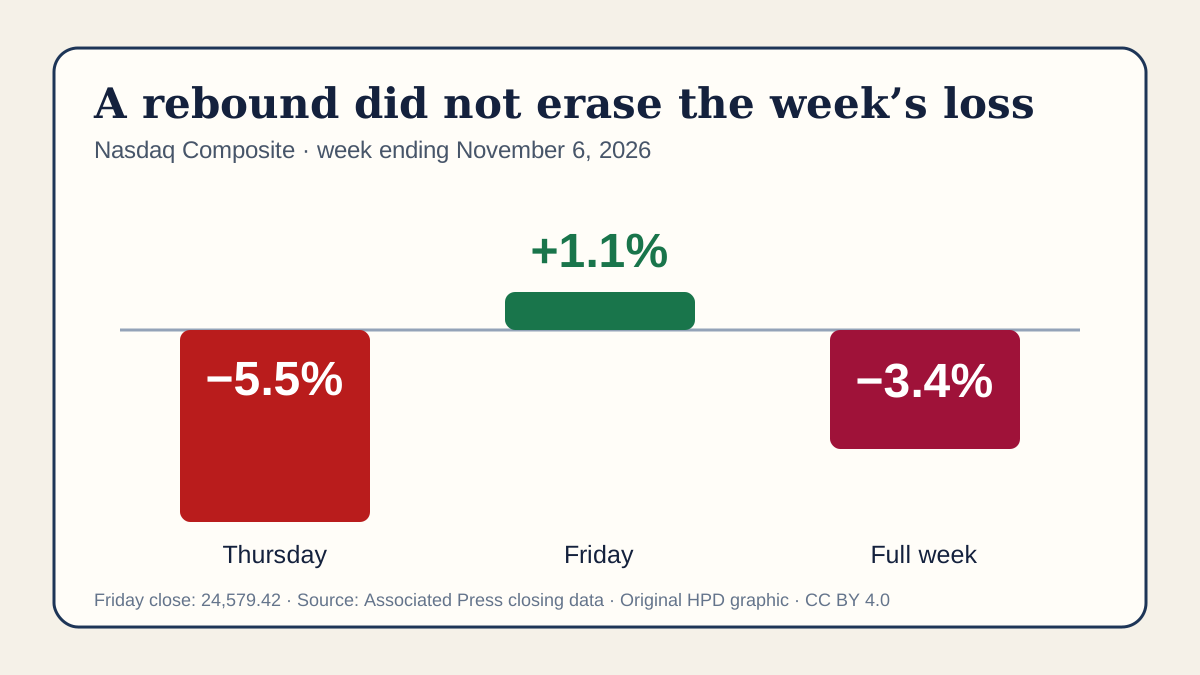
Verified baseline: a partial recovery, not a reversal
The Nasdaq Composite rose 264.43 points, or 1.1%, on Friday to close at 24,579.42, according to Associated Press closing data. For the full week it lost 857.57 points, or 3.4%.
The broader S&P 500 gained 0.3% Friday but ended the week down 2.7%. The Dow Jones Industrial Average fell 0.5% Friday and lost 0.9% for the week. Those different results show that the rebound was concentrated rather than a uniform rise across the market.
Nasdaq’s index description says the Composite includes more than 2,500 domestic and international common stocks listed on its exchange. It is technology-heavy, but it is not identical to “the technology sector” or to any one company.
Why technology shares bounced
Chipmakers and other AI-linked companies regained ground after Thursday’s sharp decline. Reuters reported that semiconductor shares led the recovery as investors reassessed the speed and extent of potential regulation and data-center constraints after the midterm elections.
The rebound does not settle the debate over AI valuations, capital spending, electricity demand or local limits on data centers. Prices can rise after a steep selloff because traders cover short positions, rebalance portfolios or judge that the previous move went too far; none of those explanations guarantees a lasting recovery.
Thursday’s 5.5% Nasdaq drop put the index into a correction, commonly defined as at least 10% below a recent peak. Health Politics Daily’s report on the selloff explains the valuation and policy concerns behind that move.
The jobs report complicated the picture
The same day, the Bureau of Labor Statistics reported that U.S. employers added 165,000 jobs in October and unemployment held at 4.1%. The official employment release showed stronger hiring than forecasters expected.
That is positive for workers and household income, but financial markets may also interpret resilient hiring as giving the Federal Reserve more room to keep interest rates high or raise them again if inflation remains elevated. The report therefore supported growth expectations while also creating a potential headwind for rate-sensitive shares. See Health Politics Daily’s people-first guide to the October jobs report.
What this means for households
- Retirement accounts: a broad workplace plan may hold U.S. and international stocks, bonds and cash. The Nasdaq’s daily move is not the same as the return on a diversified account.
- Employees in technology: share-price volatility can affect equity compensation and corporate financing, but it does not by itself announce layoffs, hiring freezes or canceled projects.
- Consumers and borrowers: the jobs report and next week’s inflation data may influence interest-rate expectations, but one trading session does not change a loan contract or the Federal Reserve’s policy rate.
- Individual investors: market moves are not personalized signals to buy or sell. Decisions depend on time horizon, diversification, taxes and capacity for loss.
This coverage is general information, not personalized investment advice.
Fact, analysis, forecast and opinion
Verified fact: the Nasdaq gained 1.1% Friday and lost 3.4% for the week. Analysis: the rebound reduced, but did not erase, the damage from Thursday’s selloff. Forecast: AI regulation, company spending, inflation and Federal Reserve expectations may keep volatility elevated, but the direction and size of future moves are unknowable. Opinion: Health Politics Daily does not recommend any security, fund or market-timing strategy.
What remains uncertain
Investors still lack final details on how the incoming Congress and newly elected state governments will approach AI, data-center permitting, electricity costs and water use. Company earnings will determine whether revenue growth can justify the sector’s spending and valuations.
Next week’s consumer- and producer-price reports could change interest-rate expectations. A further rally would not prove the correction is over, just as another decline would not establish that every AI-related business has the same risks.
Bias Lens: political shock, market mechanics or tentative recovery?
Verified baseline: the Nasdaq rose 1.1% Friday, closed at 24,579.42 and ended the week down 3.4%. The S&P 500 rose 0.3% Friday and lost 2.7% for the week.
Left-leaning — The Guardian: foregrounded the global technology rout, midterm-driven expectations for stricter AI oversight and data-center opposition. Center — Associated Press: emphasized the mixed Friday close, exact index changes and the fact that every major U.S. index still lost ground for the week. Right-leaning — Fox News Digital and Fox Business: led with the rebound in AI and chip shares while noting that Friday recovered only part of Thursday’s losses.
The difference is mainly emphasis: political and infrastructure pressures, final market arithmetic, or signs of recovery. None of the three can establish from one session whether valuations have reset enough or what markets will do next.
Principal sources
- Nasdaq — Composite index description and market data
- Associated Press — final Friday and weekly index changes
- Reuters — market drivers and sector performance
- U.S. Bureau of Labor Statistics — October employment report
No directly relevant official or publisher-authorized video with clear embedding permission was available at publication, so no video was embedded.
No comments yet.