Finance · U.S. Economy · Labor
U.S. Added 165,000 Jobs in October as Unemployment Held at 4.1%
Payroll growth was much stronger than economists expected and prior months were revised higher. The report was not uniformly strong: involuntary part-time work rose, hiring remained concentrated and October inflation data are still ahead.
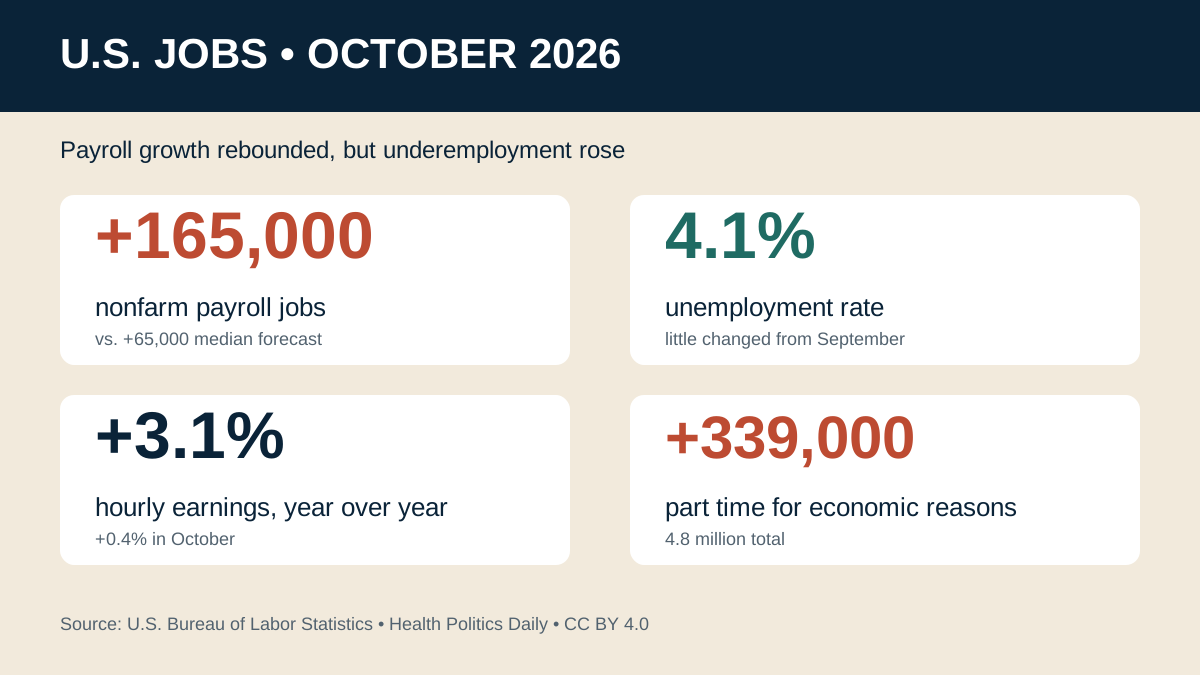
Verified baseline: 165,000 jobs added, unemployment at 4.1%
U.S. employers added a seasonally adjusted 165,000 nonfarm payroll jobs in October, and the unemployment rate changed little at 4.1%, the Bureau of Labor Statistics reported Friday. The payroll gain was more than twice the 65,000 median forecast in surveys by Reuters and the Associated Press.
BLS revised August payroll growth up from 133,000 to 186,000 and September from 29,000 to 60,000. Together, those two months now show 84,000 more jobs than previously reported. The revisions reduce the likelihood that September’s weak estimate represented an abrupt break in employment growth, though one strong report does not establish a durable trend.
Where the jobs came from
Professional and business services added 70,000 jobs, health care added 42,000, and transportation and warehousing added 25,000. Manufacturing continued to trend up with a 19,000 gain. Most other large industries—including construction, retail, financial activities, leisure and hospitality, social assistance and government—showed little change.
The concentration matters. October’s total was well above the prior 12-month average of 48,000 jobs a month, but the report did not show broad acceleration across the entire economy. Within health care, hospitals added 16,000 jobs, home health care 11,000 and outpatient care centers 5,000.
Why the household data are less comfortable
The unemployment rate has stayed between 4.1% and 4.3% since March, and the labor-force participation rate was little changed at 61.9%. But the number of people working part time for economic reasons rose by 339,000 to 4.8 million. These workers wanted full-time jobs but had their hours reduced or could not find full-time work.
Long-term unemployment was little changed at 2.0 million, representing 27.6% of unemployed people. Another 6.0 million people outside the labor force said they wanted a job but were not counted as unemployed because they had not searched in the prior four weeks or were unavailable to start work. Those measures help explain why a low headline unemployment rate can coexist with a difficult search for some workers.
Wages rose, but purchasing power is not yet known
Average hourly earnings rose 0.4% in October and 3.1% over the year, stronger than pre-release forecasts of 0.3% for the month and 2.9% for the year. The average workweek held at 34.4 hours. Those are nominal wage figures: the October consumer-price report is due next week, so the employment report alone cannot show whether pay rose faster than prices.
The Federal Reserve considers employment alongside inflation and a broad range of other indicators. A stronger jobs report can affect expectations about interest rates, but it does not mechanically determine the Fed’s next decision. Inflation, financial conditions and subsequent revisions remain relevant.
Practical implications
- For job seekers: the rebound is encouraging, especially in professional services, health care and transportation, but it does not imply equal demand by occupation or region.
- For workers: faster nominal wage growth is useful context for pay discussions, but real purchasing power cannot be assessed until October inflation is published.
- For borrowers and investors: markets may reprice expectations for Federal Reserve policy. That response is a forecast, not a settled consequence, and this report is not personalized financial advice.
- For employers: upward revisions and a 165,000 gain argue against treating September’s original estimate as the new normal. Hiring plans still depend on sector-specific demand and costs.
- For benefit applicants: national unemployment statistics do not change individual eligibility for unemployment insurance or other programs; state rules and personal circumstances govern.
Fact, analysis, forecast and opinion
Verified fact: payrolls rose 165,000, unemployment was 4.1%, wages rose 3.1% over the year and involuntary part-time work increased. Analysis: the report is stronger than the September estimate and pre-release consensus, but its sector concentration and underemployment signal make “booming” too broad a description. Forecast: economists and markets may place more weight on a possible December rate increase, but the Fed has not committed to a decision. Opinion: Health Politics Daily does not advocate a particular interest-rate path or party’s economic program.
What remains uncertain
Payroll estimates are revised as more employers respond, and today’s 165,000 figure may change. It is not yet clear whether October begins a sustained hiring acceleration, whether the rise in involuntary part-time work persists, or how wage gains compare with October inflation. The next employment report is scheduled for December 4.
Bias Lens: rebound, resilience or a still-uneven labor market?
Verified baseline: BLS reported 165,000 added payroll jobs, 4.1% unemployment, 3.1% annual wage growth and a 339,000 rise in people working part time for economic reasons. August and September together were revised 84,000 higher.
Left-leaning — The Guardian: its rolling business coverage placed the report inside a wider story about market volatility, household pressure and the political economy. Center — Reuters and AP: emphasized the consensus forecast, limited openings for job seekers and the tension between employment resilience and household purchasing power. Right-leaning business coverage — Fox Business: highlighted an earlier private-payroll estimate beating expectations and employer demand.
These sources were still updating as the official report arrived. Their different emphasis—markets and household strain, survey consensus and labor-market balance, or upside hiring signals—does not alter the BLS baseline. The most reliable comparison is to keep the official figures first and treat political or market implications as analysis.
Principal sources
- Bureau of Labor Statistics — October Employment Situation
- Bureau of Labor Statistics — survey methods and technical note
- Federal Reserve — employment and price-stability mandate
- Reuters — economist consensus and pre-release context
- Associated Press — labor-market and household context
No directly relevant official or publisher-authorized video with clear embedding permission was available at publication, so no video was embedded.
No comments yet.