Health Policy · Organ Transplantation · Medicare
CMS Final Rule Tightens Organ Procurement Oversight and Competition
The new rule clarifies when unsafe organ-procurement groups can be decertified, changes performance accounting and sets transition requirements when service areas change hands. It does not allocate organs or guarantee a transplant.
By Health Politics Daily News Desk · October 31, 2026 at 12:00 p.m. ET
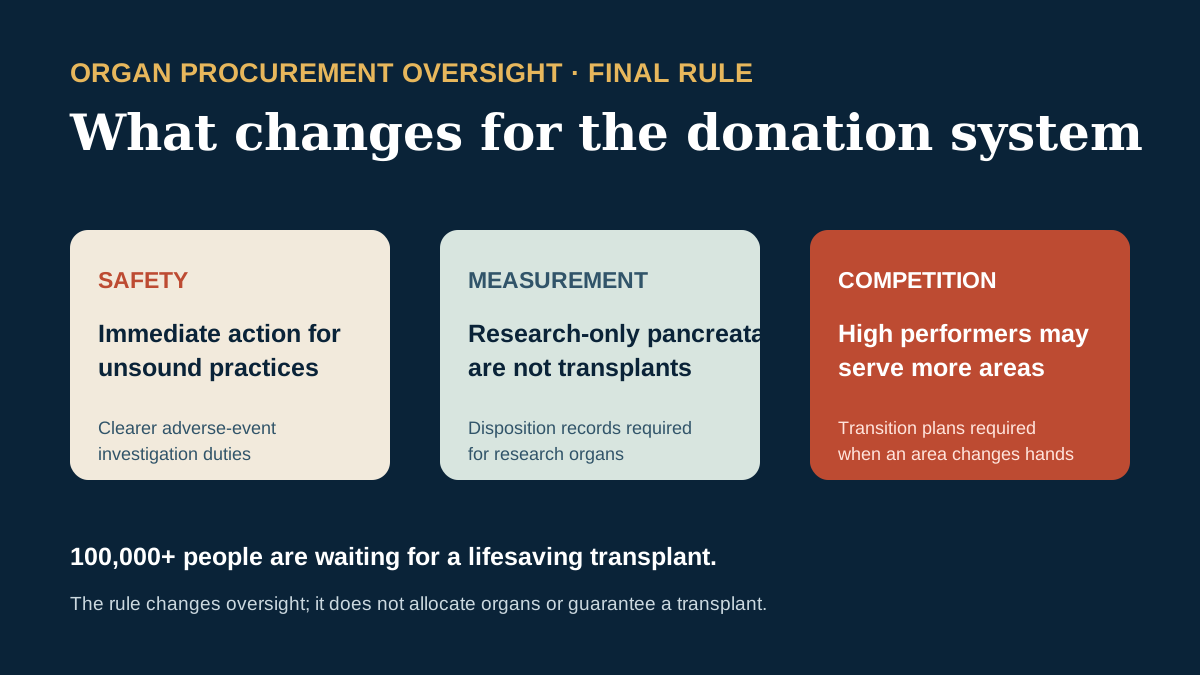
Verified baseline
The Centers for Medicare & Medicaid Services finalized revisions to the conditions governing organ procurement organizations, or OPOs, on October 30. OPOs secure donation authorization, recover organs and coordinate delivery between hospitals and transplant programs.
CMS says more than 100,000 people are waiting for lifesaving transplants and more than 49,000 transplants were performed in 2025. The public-inspection rule is scheduled for Federal Register publication November 3 and takes effect 60 days afterward.
What changes for patient safety
The rule defines “unsound medical practices” as failures that create an imminent threat to patient health and safety or pose a risk to patients or the public. That clarifies when CMS may use existing authority to decertify an OPO immediately.
OPOs must maintain quality programs with policies to identify, report, analyze and prevent adverse events. Medical directors must hold a license in at least one state or territory within an area the organization serves.
Research organs and performance scores
A pancreas recovered only for islet-cell research will continue to count toward an OPO's donation rate, but research alone will no longer count as a transplant. CMS says this makes the transplantation measure reflect organs actually transplanted into patients.
Organizations must also document what happens to organs recovered for bona fide research. The change addresses a disputed metric sometimes called the “pancreas loophole,” while preserving credit for donation and legitimate research.
Competition and service-area transitions
The existing three-tier framework remains. Top-performing tier 1 organizations can compete for multiple donation service areas. Tier 2 areas face competition, but tier 2 status by itself is not a basis for decertification. Organizations with only tier 3 areas are subject to decertification and cannot compete for another open area.
When an area changes operators, the outgoing OPO must cooperate and the successor must submit a transition plan with progress reports. The purpose is to prevent interruptions for donor families, hospitals and patients during a handoff.
What the rule does not do
The rule does not announce the closure of a specific OPO, change an individual patient's wait-list priority or promise that an organ will become available sooner. Allocation policy, transplant-center decisions and patient eligibility operate through separate systems and clinical judgments.
CMS dropped proposed definitions for medically complex organs and some broader workforce requirements after commenters raised implementation concerns. The agency also deferred electronic hospital-referral requirements for possible future rulemaking.
Practical implications
- Patients: continue working with transplant teams and use official wait-list resources; this rule does not change personal medical advice or organ availability today.
- Donor families: OPO transitions are supposed to preserve uninterrupted services and clearer accountability.
- Hospitals and OPOs: review adverse-event, research-organ, licensing and transition policies before the effective date.
- Researchers: research use remains recognized, but it cannot be reported as a transplant when no transplant occurred.
Fact, analysis, forecast and opinion
Verified fact: CMS finalized safety, measurement, competition and transition rules for OPOs. Analysis: the most consequential changes are a clearer urgent-decertification standard and more accurate transplant-rate accounting. Forecast: competition and litigation may intensify as CMS applies the tier system, but effects on donation and transplantation totals cannot yet be measured. Opinion: Health Politics Daily supports transparent outcome measures and uninterrupted service while taking no position on any individual OPO's certification.
Bias Lens: accountability reform or disruptive competition?
Verified baseline: the rule preserves the three-tier framework, clarifies safety enforcement, excludes research-only pancreata from transplant counts and requires transition planning.
A strict left-center-right comparison is not especially meaningful because this is a technical health regulation with cross-partisan roots. Government frame — CMS: emphasizes accountability, competition and more organs reaching patients. Health-industry frame — Becker's Hospital Review: focuses on compliance, costs and provisions CMS removed after comments. Reform-focused frame — Vox: previously highlighted the research-pancreas metric as a loophole; OPO-sector frame has stressed that organizations followed the prior legal metric and warns that poorly managed competition can disrupt service. These differences concern incentives and implementation, not whether transplant patients need better outcomes.
What remains uncertain
CMS has not yet shown which service areas will change operators under this rule. The effects on procurement rates, transplant volume, costs and continuity will depend on future competitions and enforcement. Court challenges by affected organizations may also alter timing.
Principal sources
- Federal Register — final rule text
- CMS — final-rule fact sheet
- CMS — official announcement
- HRSA — transplant-system modernization and safety oversight
- Becker's Hospital Review — independent implementation summary
No suitable directly relevant official or publisher-authorized video with clear persistent embedding permission was available.
No comments yet.