U.S. Politics · Elections · Federal Courts
DOJ Asks Court to Isolate Alaska Senate Ballots as Criminal Probe Intensifies
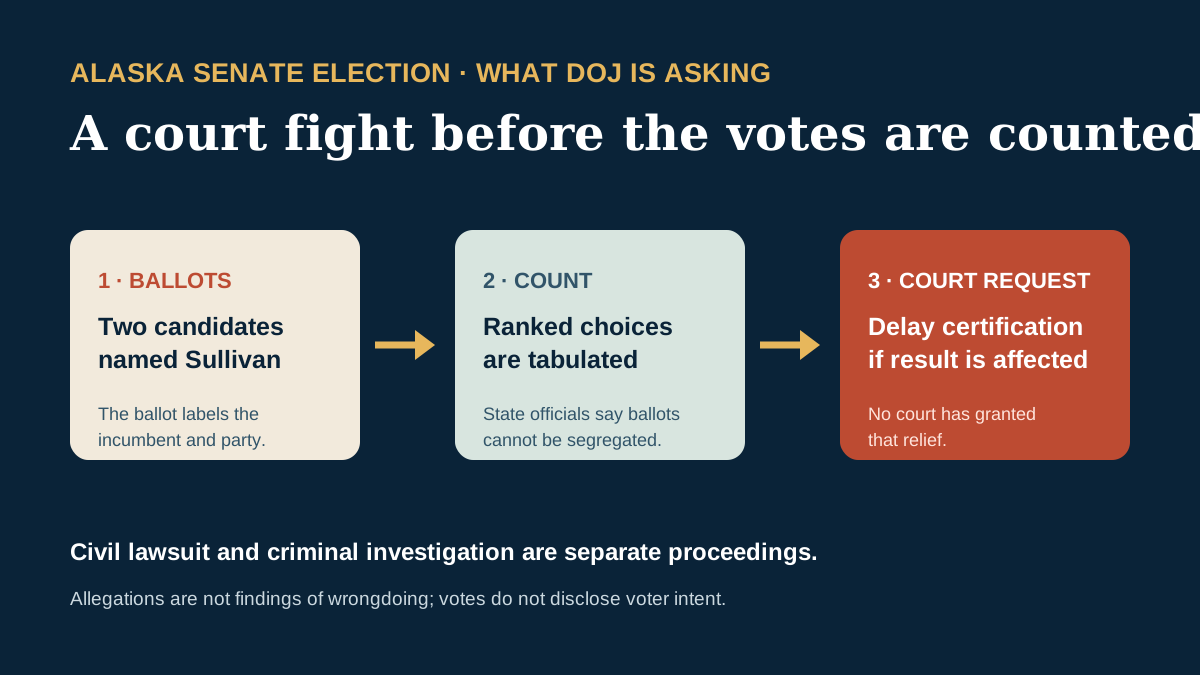
The Justice Department wants expedited discovery and preservation of ballots ranking a second candidate named Daniel Sullivan. Alaska says ballots cannot be segregated without threatening secrecy, and no court has found wrongdoing.
By Health Politics Daily News Desk · October 31, 2026 at 10:00 a.m. ET
Verified baseline
The Justice Department asked a federal judge on October 30 for expedited discovery and preliminary relief in United States v. Alaska. The government wants the state to preserve and, if feasible, segregate ballots ranking Daniel J. Sullivan Jr., a nonpartisan candidate who shares a name with Republican incumbent Sen. Dan S. Sullivan.
The civil suit, filed October 22 and amended October 29, seeks to delay certification only if the incumbent loses and votes ranking the other Sullivan could have changed the result. The court has accelerated briefing but has not granted that request.
Why two Sullivans are on the ballot
Alaska election officials initially concluded that Daniel J. Sullivan Jr.'s candidacy was intended to confuse voters and removed him. A state court restored him, and the Alaska Supreme Court affirmed that result in June. The official ballot identifies Sen. Sullivan as the Republican incumbent and lists Daniel J. Sullivan Jr. without a party affiliation.
Under Alaska's ranked-choice system, voters may rank multiple candidates. State officials argue that a voter uncertain between the two Sullivans can rank both and that the state cannot infer from a secret ballot which person a voter intended to support.
What changed on Friday
DOJ filed requests for sworn answers and depositions from Democrat Mary Peltola's campaign and the Democratic Senatorial Campaign Committee. Separately, U.S. Attorney Michael Heyman publicly confirmed a months-long criminal investigation and said recent reporting produced a surge of federal resources.
Grand jury subpoenas and an investigation establish neither a criminal charge nor guilt. Prosecutors have not publicly identified a target or a specific suspected offense. Peltola, her campaign and Daniel J. Sullivan Jr. deny coordinating an effort to mislead voters.
Why Alaska opposes segregation
State officials say completed ballots are commingled and that separating ballots based on one ranked choice could compromise ballot secrecy. Their motion to dismiss also argues that DOJ relies on the National Voter Registration Act, a law addressing registration rather than candidate placement, ballot counting or certification.
DOJ says the statute's purpose of protecting election integrity and the Constitution's Supremacy Clause support federal intervention. Those are litigating positions, not settled law. Judge Sharon Gleason must decide jurisdiction, legal authority and whether any requested remedy is workable.
Practical implications
- Alaska voters: the election is proceeding. The official candidate list distinguishes the incumbent by status and party; voters can rank candidates in order of preference.
- Election officials: the immediate dispute concerns preservation, discovery and possible certification—not whether ballots should be cast or counted now.
- The Senate: a certification delay in a close race could postpone seating Alaska's winner and affect control of the chamber.
- Public discussion: claims about recruitment, conspiracy or fraud remain allegations unless proved through evidence and due process.
Fact, analysis, forecast and opinion
Verified fact: DOJ filed new civil motions and confirmed a separate criminal investigation. Analysis: the requests test the federal government's power to intervene in state certification before any final vote count exists. Forecast: the district court is likely to act quickly because Election Day is November 3, but the outcome and any appeal remain uncertain. Opinion: Health Politics Daily takes no position on the candidates; courts and prosecutors should distinguish genuine evidence from partisan inference and protect ballot secrecy.
Bias Lens: election integrity or federal overreach?
Verified baseline: two similarly named candidates are legally on Alaska's ballot; DOJ seeks conditional relief and expedited discovery; Alaska and intervenors seek dismissal; no court has found a conspiracy or voter confusion.
Left-leaning/civil-liberties — ACLU of Alaska: emphasizes voter representation and argues the federal statute does not authorize intervention. Center — Associated Press: distinguishes the civil filing, criminal probe and Alaska's ballot-secrecy objection. Right-leaning — National Review: treats the namesake candidacy as a Democratic dirty trick while also questioning DOJ's reliance on a broad statutory purpose clause. The disagreement is strongest over motive and federal authority; the court record, not political framing, determines relief.
What remains uncertain
The evidence supporting the criminal investigation, the legal basis for any charges, whether voters were actually confused, whether ballots can lawfully be isolated and whether the civil case survives dismissal all remain unresolved. The final margin is also unknown because voting is still underway.
Principal sources
- Federal case docket and October 29–30 filings
- Alaska Division of Elections — official candidate list
- Alaska Division of Elections — June determination
- Associated Press — new motions, criminal probe and state response
- Reuters — final-weekend election context
No suitable directly relevant official or publisher-authorized video with clear persistent embedding permission was available.
No comments yet.