Global Health · Infectious Disease · Africa
Congo Ebola Death Toll Passes 5,000 as Untracked Transmission Persists
The official count reached 5,026 deaths among 10,351 confirmed infections. The number marks a severe response burden, while gaps in contact tracing and access to care make the outbreak's trajectory uncertain.
By Health Politics Daily News Desk · October 31, 2026 at 8:00 a.m. ET
Verified baseline
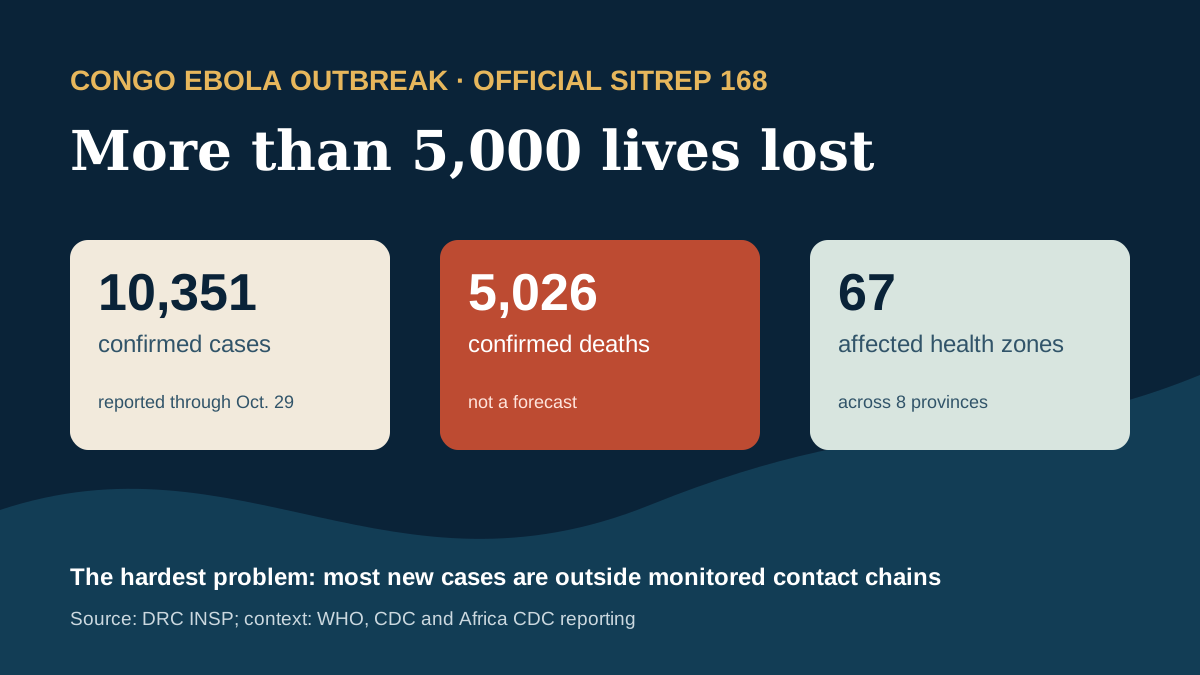
The Democratic Republic of Congo's National Institute of Public Health recorded 10,351 laboratory-confirmed cases and 5,026 deaths in situation report 168, covering data through October 29. The outbreak has reached 67 of the country's 178 health zones across eight provinces; 50 zones still had active cases, according to reporting based on the same national data.
This is an update to Health Politics Daily's October 27 report on the 10,000-case threshold. The consequential new fact is the official death toll crossing 5,000, alongside continued evidence that many transmission chains remain outside surveillance.
Why the milestone matters
Five thousand deaths is not merely a statistical threshold. It represents families and communities affected across a large response area and confirms this as the second-deadliest Ebola outbreak on record, behind the 2014–2016 West Africa epidemic.
The crude fatality proportion in Congo's confirmed data is about 48.6%. That figure describes reported outcomes to date; it is not an individual's prognosis. Survival can depend on timely detection, supportive care, underlying health and other circumstances, while delayed reporting can change the ratio.
Contact-tracing gaps are sustaining risk
Africa CDC has said about 80% of new cases were being found outside monitored contact chains. That means health teams often learn of infections without having already identified the person as exposed, leaving opportunities for earlier testing and isolation unrealized.
WHO also told the Associated Press that roughly one-third of recorded deaths occurred outside treatment centers. Community deaths can reflect delayed recognition, limited access, distrust, insecurity or overwhelmed services. They also make safe care and burial practices harder to organize.
What the number does—and does not—mean
The outbreak is caused by Bundibugyo virus, for which there is no approved strain-specific vaccine or antiviral treatment. Care focuses on symptoms and complications, while case finding, isolation, infection control, contact monitoring and safe burials remain central. Experimental vaccine research is underway, but participation in a study is not proof that a broadly available preventive tool exists.
The milestone does not mean Ebola spreads casually through the air. Infection generally requires direct contact with blood or other bodily fluids of a symptomatic infected person, contaminated objects or infected animals. The CDC said on October 30 that no related U.S. cases had been confirmed and that risk to the American public and travelers remained low.
Practical implications
- People in affected areas: follow local health-authority guidance and seek official advice promptly after a possible exposure or compatible symptoms.
- Travelers: WHO advises against travel or trade restrictions on affected countries; CDC provides current precautions.
- Health systems: rapid triage, protective equipment, laboratory access and paid, protected response teams remain essential.
- Readers elsewhere: the geographic spread warrants preparedness, not stigma. This report is general information, not personalized medical advice.
Fact, analysis, forecast and opinion
Verified fact: Congo's official report counted 5,026 deaths and 10,351 confirmed cases through October 29. Analysis: the high share of infections outside monitored contacts shows that detection is lagging behind transmission. Forecast: totals may continue to rise, but the timing and scale cannot be predicted reliably from a milestone alone. Opinion: Health Politics Daily favors transparent daily reporting, safe access to care and protection for responders, without endorsing broad travel bans or alarmist claims.
Bias Lens: how should the 5,000-death milestone be framed?
Verified baseline: the DRC's national situation report lists 10,351 confirmed cases and 5,026 deaths through October 29; CDC says U.S. and traveler risk remains low, while WHO advises against travel and trade restrictions.
A conventional left-center-right comparison is not meaningful for this epidemiological update: there is no substantive partisan dispute over the national count, and forcing one would create false symmetry. Primary-source frame — CDC and WHO: emphasize transmission, preparedness and calibrated risk. Independent wire frame — Associated Press: centers the human toll, untracked cases, treatment access and exhausted responders. The frames are complementary: official agencies prioritize operational guidance, while field reporting shows what response failures mean for people.
What remains uncertain
Confirmed totals may miss infections where testing and access are limited. It is not yet clear when transmission will fall across all active zones, how well vaccine candidates will perform, or whether staffing, security and funding gaps will improve. Cross-border cases demand surveillance, but they do not establish sustained community transmission in every country that has reported an imported case.
Principal sources
- INSP situation-report archive — SitRep 168 and daily official totals
- World Health Organization — October 23 outbreak update
- U.S. CDC — October 30 situation and risk assessment
- Associated Press — field reporting and current national totals
No suitable directly relevant official or publisher-authorized video with clear persistent embedding permission was available.
No comments yet.