U.S. Health Policy · Civil Rights · Disability Law
HHS Final Rule Excludes Most Gender Dysphoria Claims From Section 504 Disability Coverage
Beginning January 2, HHS-funded programs must treat gender dysphoria not resulting from a physical impairment as excluded from Section 504's definition of disability. The rule narrows one legal route; it does not resolve every civil-rights protection or treatment policy.
By Health Politics Daily News Desk · October 31, 2026 at 6:00 a.m. ET
Verified baseline
The Department of Health and Human Services published a final rule interpreting the Rehabilitation Act's exclusion for “gender identity disorders not resulting from physical impairments” to include gender dysphoria not resulting from a physical impairment. The change becomes effective January 2, 2027.
Section 504 prohibits disability discrimination in programs and activities receiving federal financial assistance. For HHS, that includes a wide range of hospitals, clinics, insurers, state agencies, social-service providers and other recipients. The rule amends HHS's regulation at 45 C.F.R. Part 84; it is not a new act of Congress.
What the rule changes
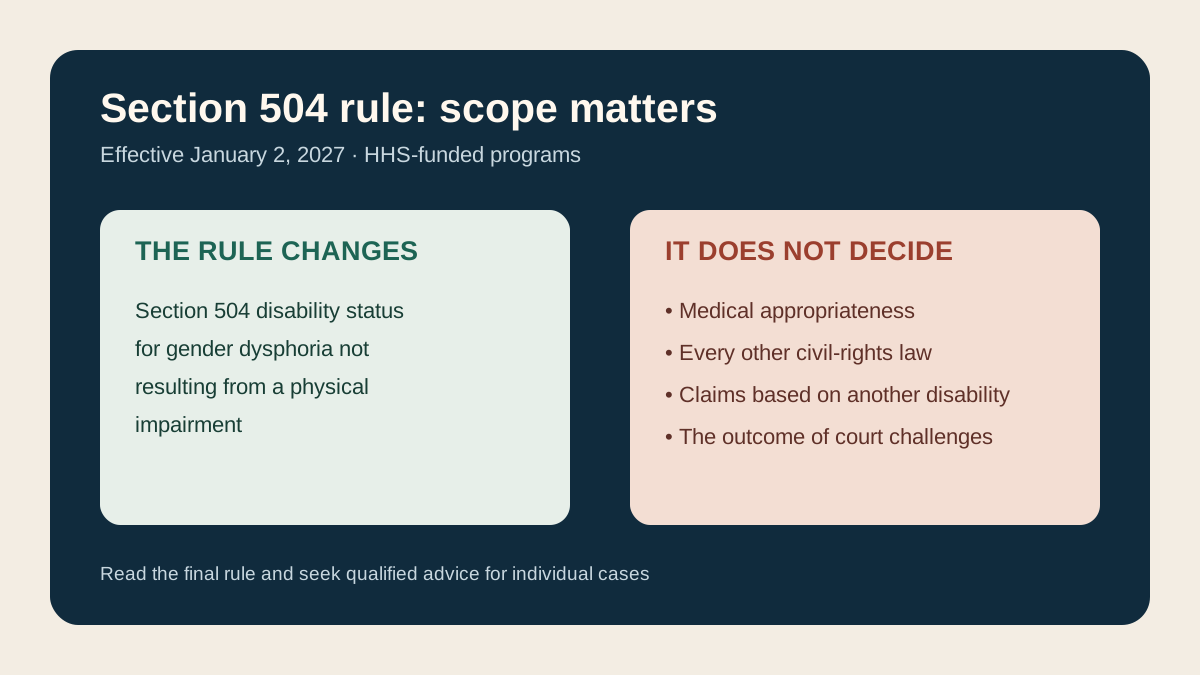
Under the new regulation, a person cannot establish Section 504 disability status in an HHS-funded program solely on the basis of gender dysphoria that does not result from a physical impairment. The text preserves the statute's physical-impairment qualification, so claims involving such an impairment may require a different factual analysis.
HHS says the rule resolves ambiguity created by the preamble to its 2024 Section 504 regulation. That preamble suggested gender dysphoria could be distinct from the older statutory term “gender identity disorders,” although the operative 2024 regulatory text did not expressly classify gender dysphoria as a disability.
What the rule does not decide
The rule does not itself prohibit or require any medical treatment. It does not determine whether a particular procedure is medically appropriate, and it is separate from federal funding policies for gender-related care.
It also does not erase protections a person may have because of another disability, a physical impairment or a different federal or state civil-rights law. Section 1557 of the Affordable Care Act, Title IX, state nondiscrimination statutes, constitutional claims and employment law have distinct text, coverage and court precedents. Whether any applies depends on the program and facts.
Why litigation is likely
The legal dispute turns on whether modern gender dysphoria is encompassed by Congress's older exclusion for “gender identity disorders not resulting from physical impairments.” HHS says the statutory language compels its interpretation.
The Fourth U.S. Circuit Court of Appeals reached a different conclusion in Williams v. Kincaid in 2022, holding that gender dysphoria was not categorically the same as the excluded conditions and could qualify as a disability. HHS's own regulatory agenda identifies that decision as a litigation risk, while noting other courts have disagreed. The Supreme Court declined to review Williams, which leaves the appellate ruling intact within the Fourth Circuit but does not create a nationwide Supreme Court precedent.
Practical implications
- Patients and families: a denial of accommodation or service may involve more than this rule. Legal-aid and civil-rights organizations can assess the program, location and other possible protections.
- HHS-funded organizations: policies and complaint procedures should be reviewed before January 2, while preserving obligations involving other disabilities and laws.
- People with pending complaints: the effect may depend on timing, jurisdiction and the precise legal claim. This article provides general information, not legal or medical advice.
- Clinicians: the regulatory definition does not decide a diagnosis or treatment plan and should not substitute for professional standards or individualized care.
Fact, analysis, forecast and opinion
Verified fact: HHS finalized a Section 504 definition that excludes gender dysphoria not resulting from physical impairment, effective January 2. Analysis: the practical effect is narrower than a nationwide health-care ban but significant for accommodation and discrimination claims in federally funded health programs. Forecast: civil-rights groups are likely to sue, with the Fourth Circuit's contrary reasoning central to early cases. Opinion: Health Politics Daily takes no position on the merits of gender-related treatment; agencies and advocates should describe this rule's legal scope without overstating it.
For related reporting, see our coverage of the New Zealand court ruling on puberty-blocker regulations and the federal ruling on Medicaid's medical-frailty test.
Bias Lens: statutory clarification or civil-rights rollback?
Verified baseline: the rule excludes gender dysphoria not resulting from physical impairment from Section 504 disability coverage in HHS-funded programs; it does not itself ban treatment.
Left-leaning/civil-rights — Center for Public Representation: calls the rule politically motivated and emphasizes loss of a disability-discrimination remedy. Center/legal — Bloomberg Law: frames it as a reversal of the prior administration and focuses on the changed regulatory definition. Right-leaning — Fox News: in coverage of the proposal, presents it as restoring statutory limits within a broader administration effort against gender-related care. These frames differ over agency authority and civil-rights impact; the controlling text and court decisions determine legal effect.
What remains uncertain
The rule's application to pending matters, the meaning of “resulting from a physical impairment,” the interaction with other civil-rights laws and the outcome of expected lawsuits remain unresolved. HHS received more than 380 public comments, but courts—not the agency's press release—will ultimately decide whether the interpretation is lawful.
Principal sources
- Federal Register — final rule text and agency responses
- HHS Office for Civil Rights — official announcement
- HHS — Section 504 scope and enforcement
- Office of Information and Regulatory Affairs — legal and litigation analysis
- Bloomberg Law — independent legal reporting
No suitable directly relevant authorized video with clear persistent embedding permission was available.
No comments yet.