U.S. Politics · Elections · Voting
More Than 43 Million Americans Vote Early as Midterm Pace Surges
Advance voting is nearly 10 million ballots ahead of the comparable 2022 point, with especially large increases in several states holding competitive Senate races.
By Health Politics Daily News Desk · October 30, 2026 at 9:56 p.m. ET
Verified baseline
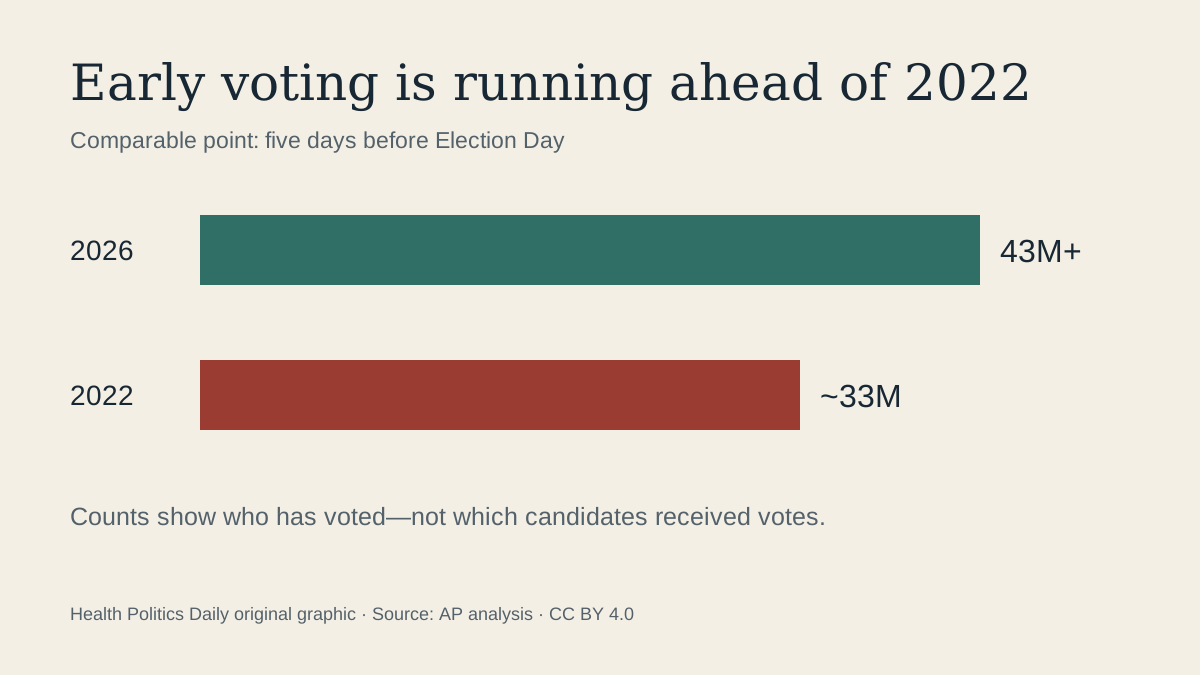
More than 43 million Americans had voted early in person or returned mail ballots by October 30, five days before the November 3 midterm election, according to an Associated Press analysis covering 47 states and Washington, D.C. That was nearly 10 million more than at the comparable point in 2022.
The University of Florida Election Lab’s tracker, compiled from state election offices, also showed the national total had moved above 44 million by late October 29. Reporting schedules differ by state, so national totals are snapshots rather than a synchronized census.
Where the increases are largest
AP found Texas more than 50% ahead of its 2022 pace, with over 6.3 million early votes. Maine, Michigan, North Carolina and Kansas were more than 30% ahead, while South Carolina’s increase was about 83%. Competitive Senate races are drawing particular attention in several of those states.
Higher totals can reflect voter enthusiasm, population growth, calendar differences, campaign strategy, state law and voters shifting from Election Day to advance voting. They do not necessarily mean final turnout will increase by the same percentage.
What party-registration data means
In states reporting party affiliation, about 6.8 million registered Democrats and 5.2 million registered Republicans had voted in AP’s count. Those figures cover only part of the country. Registration is not a vote choice, and unaffiliated voters form a substantial group.
Election officials generally do not report candidate selections before polls close. Claims that early-vote registration totals prove a winner confuse voter identity with ballot content and ignore expected differences in Election Day voting.
Why the surge matters
A larger advance vote reduces the number of ballots left for Election Day and can help campaigns target remaining supporters. It also increases the volume that election offices must verify, process and report. Depending on state law, mail ballots may be prepared before Election Day even when tabulation or public release waits until polls close.
The pace may also reduce some weather-related risks for people who already voted, while placing greater importance on ballot-curing deadlines for voters whose mail ballots have signature or identification issues.
Fact, analysis, forecast and opinion
Verified fact: advance voting is substantially ahead of the comparable 2022 point, with large state-by-state variation. Analysis: the shift reflects both engagement and changes in when people vote. Forecast: the surge could produce a high-turnout midterm, but Election Day participation and outstanding mail ballots make final turnout unknowable. Opinion: Health Politics Daily takes no position on candidates; outlets should avoid projecting outcomes from incomplete registration data.
Practical implications for voters
- Check status: voters who returned mail ballots can use their state or local election office’s official tracker.
- Correct problems: follow official curing instructions promptly; deadlines and accepted documents vary by state.
- Avoid double voting: a person unsure whether a ballot was received should contact election officials rather than submitting another ballot without instructions.
Related site coverage includes the California election-worker subpoenas and the injunction restricting federal election operations.
Bias Lens: turnout signal or partisan forecast?
Verified baseline: more than 43 million advance ballots had been cast, nearly 10 million above the comparable 2022 point. The data does not reveal candidate selections.
Left-leaning — The Guardian: presents the surge amid campaign conflict and Democratic opportunities. Center — Associated Press: emphasizes comparable state data and repeatedly warns that affiliation is not vote choice. Right-leaning — Wall Street Journal: focuses on the battleground implications and Texas increase. The framing differs; the common measurable baseline is the turnout pace, not a predicted winner.
What remains uncertain
Final turnout, the partisan composition of Election Day voting, rejection and curing rates, and election outcomes remain unknown. Comparisons may change as states update delayed reports.
Principal sources
- Associated Press — national and state-by-state comparable analysis
- University of Florida Election Lab — tracker and methodology cautions
- U.S. Election Assistance Commission — official voter information
No suitable item-specific authorized video with clear persistent embedding permission was available.
No comments yet.