U.S. Politics · Election Law · California
DOJ Subpoenas California Election Workers as Ballot Dispute Expands
Federal prosecutors have moved a dispute over alleged noncitizen voting into a grand-jury investigation, ordering election employees to testify and produce records after Election Day. The subpoenas do not establish wrongdoing and do not alter current ballot-counting procedures.
By Health Politics Daily News Desk · October 29, 2026 at 9:57 p.m. ET
Verified baseline
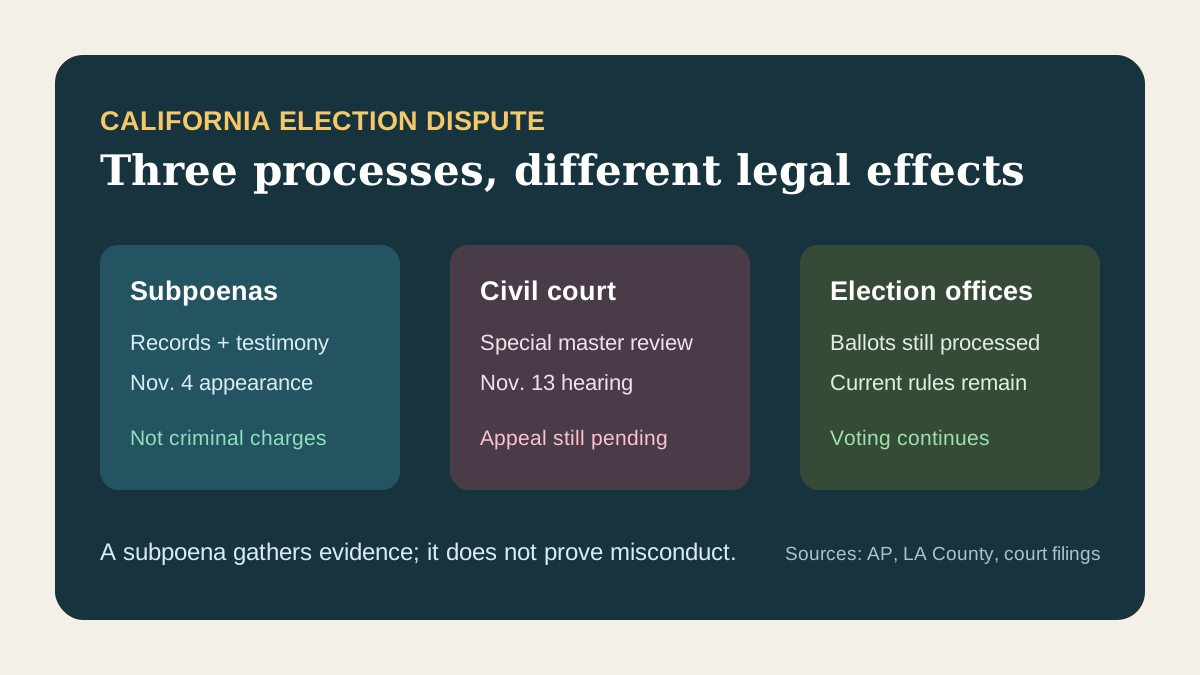
The Justice Department issued federal grand-jury subpoenas to employees of the Los Angeles County Registrar-Recorder and officials in other California counties. Copies reviewed by the Associated Press and other news organizations order Los Angeles employees to appear November 4—the day after the election—and bring records about federal allegations of noncitizens on voter rolls, screening methods and communications with federal officials.
A subpoena is a legally binding demand for testimony or evidence. It is not an indictment, criminal charge or finding that the recipient committed misconduct. The documents do not publicly identify who, if anyone, is a target. A Justice Department spokesperson said receiving a subpoena generally does not mean a person is a target and argued that suspected unlawful voting should be handled through criminal law.
Los Angeles County Registrar Dean Logan said the office is following state and federal law and will protect employees while continuing to serve voters. The Justice Department has not released a full public account of the grand jury's scope, and grand-jury proceedings are normally secret.
What changes before Election Day
Nothing in the publicly reported subpoenas orders California to stop processing ballots, remove voters or change polling procedures. Current election rules remain in effect. Voters should use official state and county sources for registration, ballot-status and polling-place information.
The appearance date matters: Los Angeles employees are directed to court after voting ends, reducing the subpoenas' immediate operational effect on Election Day. Producing records can still consume staff time and create security concerns, but county offices say they remain focused on election administration.
A separate civil case is still active
The criminal inquiry runs alongside a civil lawsuit in which the Justice Department asked a federal judge to set aside ballots associated with more than 20,000 people it described as likely noncitizens. Judge David Carter denied the emergency request, questioning the list's reliability and warning that changing procedures during voting could disenfranchise eligible citizens.
Carter appointed a special master to help develop the factual record and set a later hearing, while the Justice Department appealed. The special master, the appeal and the grand jury are distinct. Evidence gathered in one process may influence later arguments, but a subpoena alone does not reverse the order or invalidate a ballot.
The disputed evidence
Noncitizen voting in federal elections is illegal. Federal prosecutors have charged several people in California with election-related offenses, and those defendants are entitled to the presumption of innocence unless convicted.
California and county officials say the broader federal list contains errors. A preliminary Los Angeles review cited in court found that many sampled registrations had been canceled, had no voting history or belonged to U.S.-born people. The Justice Department has acknowledged that citizens may appear on the list while maintaining that every potentially unlawful vote warrants investigation.
Practical implications
- California voters: the subpoenas do not cancel registrations or ballots. Check status through official county or state election websites, not social-media claims.
- Election workers: recipients must respond through counsel, but a subpoena does not itself make them defendants. Offices may seek to narrow or challenge demands through court.
- Observers: distinguish criminal charges against specific individuals from allegations about a larger voter list; they are not interchangeable.
- Election results: current ballot processing continues. Later litigation or verified evidence could affect specific disputes, but no published subpoena determines statewide results.
Fact, analysis, forecast and opinion
Verified fact: grand-jury subpoenas seek records and testimony from election employees, with Los Angeles appearances set for November 4. Analysis: the move increases pressure on local offices and broadens the dispute from emergency civil relief to criminal evidence-gathering. Forecast: recipients may comply, negotiate scope or challenge demands; no charging decision is publicly known. Opinion: Health Politics Daily takes no partisan position. Election-law enforcement should be evidence-led, transparent where legally possible and structured to avoid disrupting eligible voters.
Our earlier report on the court's rejection of DOJ's ballot request explains the civil order now under appeal. Our coverage of the FEC filing-system outage addresses a separate federal election-administration risk.
Bias Lens: enforcement or intimidation?
Verified baseline: DOJ issued subpoenas, California offices remain legally required to administer the election, and the publicly available documents do not establish that subpoena recipients committed crimes.
Left-leaning — NPR: centers worker pressure, the judge's warning about threats and uncertainty over who is under investigation. Center — Associated Press: foregrounds subpoena terms, the civil-court timeline and the limits of what is publicly known. Right-leaning — Fox News: in its coverage of the underlying dispute, emphasizes DOJ's election-integrity rationale, California's resistance and the government's appeal. These frames highlight different risks—official intimidation, unsupported claims or illegal voting—but none turns a subpoena into proof.
What remains uncertain
The grand jury's precise theory, potential targets and evidence are not public. It is unclear whether prosecutors will seek charges, whether courts will limit any requests, how the special master will evaluate the federal list or how the appeals court will rule. The number of flagged people who cast a ballot—and how many are actually noncitizens—also remains unresolved.
Principal sources
- Associated Press — subpoena copies, dates and court timeline
- CBS News — subpoena requests and DOJ and county statements
- NPR — employee status and legal context
- California Attorney General — civil ruling and state position
- U.S. Justice Department — underlying federal complaint
No directly relevant official or publisher-authorized video with clear persistent embedding permission was available, so none was embedded.
No comments yet.