International Politics · Cuba · United Nations
U.N. Cuba Embargo Vote Passes as Support Falls to 20-Year Low
The General Assembly again called for an end to U.S. restrictions, but the 130–17 vote revealed a sharp shift in diplomatic support.
By Health Politics Daily News Desk · October 28, 2026 at 11:56 p.m. ET
Verified baseline
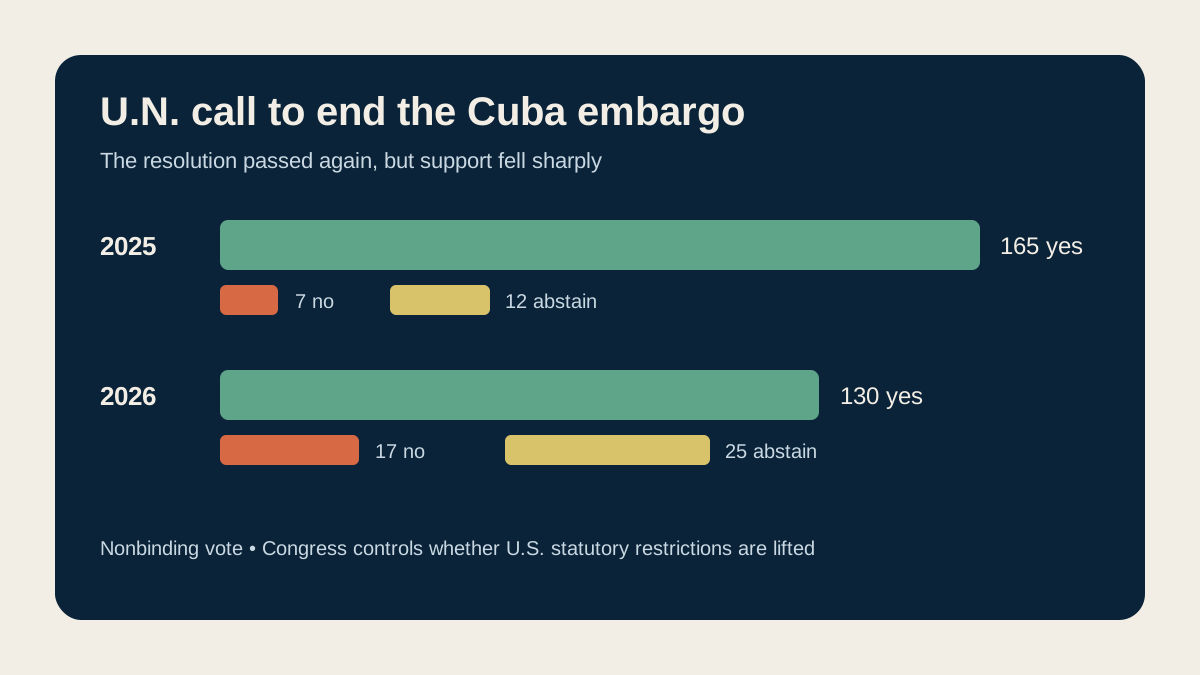
The United Nations General Assembly voted 130–17, with 25 abstentions, to adopt its annual resolution calling for an end to the United States' economic, commercial and financial embargo on Cuba. The official meeting transcript records the result and adoption of draft resolution A/81/L.5.
The resolution is not legally binding. It expresses the position of the General Assembly but does not repeal U.S. statutes, regulations or sanctions. Congress controls the core statutory embargo, while the executive branch administers and can modify some restrictions within existing law.
What changed in the vote
The 2025 resolution passed 165–7 with 12 abstentions. This year's support fell by 35 votes, opposition rose by 10 and abstentions more than doubled. U.N. News describes the 2026 result as the weakest backing for the measure in two decades.
Germany, Italy and several other Western governments abstained after previously supporting the resolution. The United States and Israel again voted against it. A lower yes total does not mean the Assembly endorsed the embargo; 130 countries still supported the call to end it.
Why support shifted
U.S. diplomats urged countries to oppose or abstain, arguing that Cuba's government uses the embargo as a defense of its domestic record and that ending restrictions without political reforms would reward repression. Cuban Foreign Minister Bruno Rodríguez said the sanctions amount to economic warfare and worsen shortages affecting ordinary people.
Those are competing political arguments. The vote itself does not measure the embargo's precise economic effects, establish the causes of every Cuban shortage or determine the Cuban government's responsibility for rights violations and economic policy.
Practical implications
- Travelers and families: the vote does not change U.S. travel categories, financial rules or customs restrictions. Current Treasury and State Department guidance still applies.
- Businesses and banks: U.S. sanctions compliance obligations remain in force; a General Assembly resolution is not a license.
- Cuban residents: the vote does not immediately restore fuel supplies, electricity reliability, imports or access to finance.
- Diplomats: the wider opposition and abstention blocs give Washington evidence of a more favorable coalition, while Havana can still point to an overwhelming majority against the embargo.
This is general reporting, not legal or financial advice.
Fact, analysis, forecast and opinion
Verified fact: the Assembly adopted the resolution 130–17 with 25 abstentions. Analysis: the result is simultaneously a diplomatic defeat for the United States on the resolution and a significant improvement for Washington compared with 2025. Forecast: the shift may encourage further U.S. lobbying and harder Cuban diplomacy, but it does not predict congressional action. Opinion: Health Politics Daily takes no position on the embargo or Cuba's political system.
For related sanctions and U.N. policy context, see our reporting on U.S. Iran-related designations and U.S. sanctions on the International Criminal Court. Those actions use different legal authorities and do not define Cuba policy.
Bias Lens: humanitarian costs, diplomatic movement and government responsibility
Verified baseline: the resolution passed 130–17 with 25 abstentions, down from 165 yes votes in 2025; it is nonbinding.
Left-leaning Al Jazeera foregrounds the embargo's humanitarian and economic burden and calls the outcome another condemnation. Center-oriented Reuters leads with the U.S. lobbying success and the numerical shift while stressing that only Congress can lift the statutory embargo. Right-leaning Fox News emphasizes Ambassador Mike Waltz's confrontation with Cuba's foreign minister and the U.S. case against Havana's government. These frames emphasize different consequences and actors; the official roll-call result remains the shared baseline.
What remains uncertain
It is unclear whether the diplomatic shift will persist, which governments will change position again next year, whether Congress will revisit Cuba sanctions or whether the administration will alter licenses and enforcement. The vote also cannot resolve competing estimates of the embargo's economic cost.
Principal sources
- U.N. General Assembly official transcript and vote
- U.N. News vote context
- Associated Press report
- Reuters report
No suitable directly relevant official video with clear persistent embedding permission was available. The article links to publisher-authorized coverage rather than embedding or rehosting footage.
No comments yet.