Global Events · Spain · Transportation Safety
Spain Train Collision Kills at Least 68 Near Urda
A Renfe AVE struck a stopped Iryo train on the Madrid–Andalusia high-speed line; rescue work and the formal cause investigation continue.
By Health Politics Daily News Desk · October 28, 2026 at 10:00 p.m. ET
Verified baseline
Castilla-La Mancha's regional government says at least 68 people were killed when two high-speed trains collided near Urda in Toledo province on Wednesday. Its provisional breakdown lists 44 people aboard the Iryo train and 24 aboard the Renfe AVE among the dead. Officials said dozens of injured people were receiving hospital care, including patients in serious condition.
The AVE was traveling from Madrid toward Seville when it hit the rear of an Iryo train that had stopped on the same track. Carriages derailed and some went down an embankment. Search, recovery and victim-identification work continued, so the toll may change.
What officials say happened
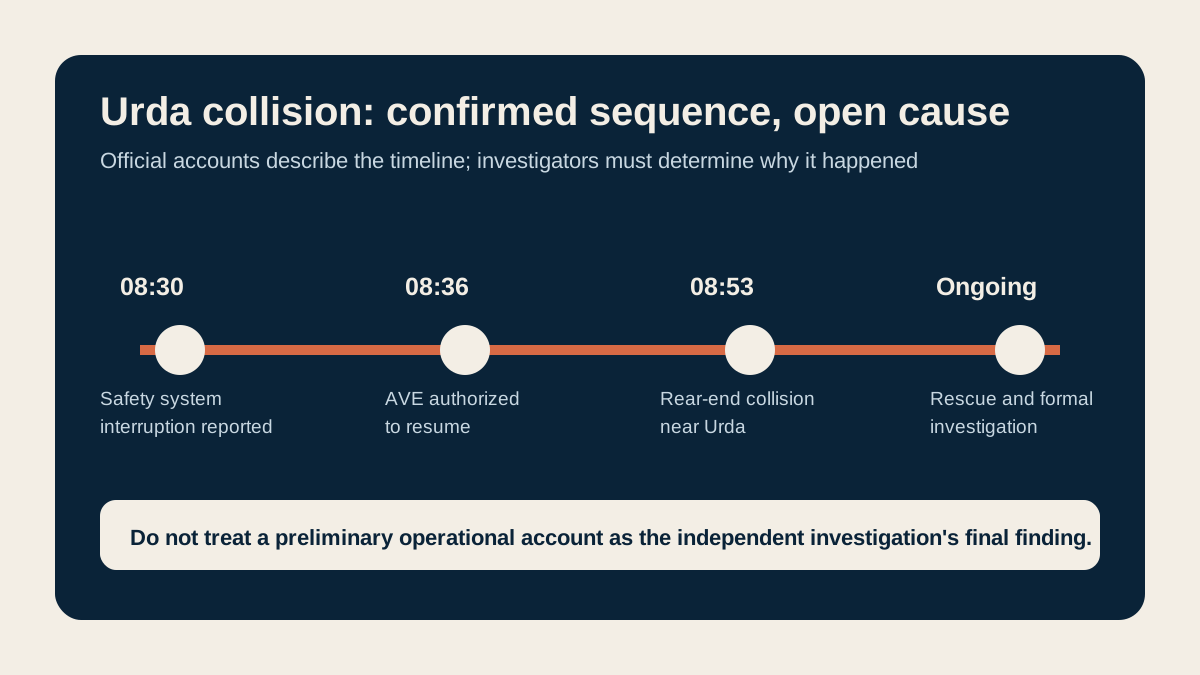
Spain's transport minister said a communications or safety-system interruption stopped multiple trains. According to his preliminary account, the control center then authorized the AVE to resume while the Iryo remained stopped ahead of it. EFE reports the collision occurred around 8:53 a.m. local time.
That account identifies an operational sequence; it is not the final determination of cause. The Independent Railway Accident Investigation Commission, judicial authorities, Adif and the operators are examining system logs, communications, signaling and human decisions. Prime Minister Pedro Sánchez said responsibility would be established if investigators find negligence or safety failures.
Emergency response and family information
The regional government activated its highest coordinated emergency response for the incident, requested the Military Emergency Unit and established a forward command post. Renfe activated its victim-and-family assistance plan. Official family information lines are 900 122 112 through Castilla-La Mancha and 900 10 10 20 through Renfe; people outside Spain should verify international dialing access through the operators' official pages.
Spain declared three days of national mourning from October 29 through October 31. The flags on public buildings, overseas missions and Navy vessels will fly at half-staff.
Travel implications
- Madrid–Andalusia service: high-speed traffic on the affected corridor was suspended. Renfe said ticket sales on the route were halted while infrastructure and operations are assessed.
- Existing bookings: passengers should use Renfe, Iryo or Adif's official channels for cancellations, rebooking and alternate transport rather than rely on screenshots or social posts.
- Family inquiries: use the official assistance numbers and avoid circulating unverified passenger lists or images that may expose victims' personal information.
- Cause claims: viral videos, AI-generated images and conspiracy claims were already circulating. A system interruption and an authorization sequence do not by themselves establish criminal fault.
Why the crash matters beyond the immediate tragedy
This is Spain's second fatal high-speed rail disaster in 2026, after the January collision near Adamuz killed 46 people. Officials say the two crashes likely arose from different circumstances, but two major failures in one year will intensify scrutiny of signaling, control procedures, maintenance and emergency readiness across Europe's largest high-speed rail network.
For other transportation-safety developments, see our reporting on the Boeing 777 freighter production halt and the Volkswagen and Audi steering recall. Those events involve different systems and do not suggest a shared cause.
Fact, analysis, forecast and opinion
Verified fact: two high-speed trains collided, the regional government reports at least 68 deaths, and the Madrid–Andalusia line was suspended. Analysis: the preliminary sequence points investigators toward traffic-control authorization and degraded-system procedures. Forecast: the corridor may face prolonged disruption and national safety reviews, but timing and policy changes are not yet known. Opinion: Health Politics Daily takes no position on individual or institutional responsibility before the independent investigation reports.
Bias Lens: tragedy, responsibility and system safety
Verified baseline: official emergency authorities confirm 68 deaths; the minister has described a preliminary authorization sequence; the independent investigation remains open.
A left-center-right comparison is not forced because the first-day reporting is dominated by emergency facts rather than a stable ideological dispute. Center-oriented Reuters emphasizes the confirmed toll, minister's account and longer-term maintenance questions. Spain's left-leaning El País provides a granular operational chronology and survivor accounts. Public broadcaster RTVE foregrounds maps, passenger totals and verified-data graphics while separately debunking false images. These differences concern evidence format and emphasis, not proof of partisan causation; official emergency records and the future commission report remain controlling.
What remains uncertain
The final number of victims, the precise status of every hospitalized person, the technical reason for the system interruption, why movement authority was given, whether safeguards performed as designed and how long the corridor will remain disrupted are all unresolved. Early descriptions should not be treated as the accident commission's conclusion.
Principal sources
- Castilla-La Mancha government casualty and response update
- Castilla-La Mancha 112 emergency information and family contacts
- Renfe accident and family-assistance statement
- Spanish government mourning and investigation statement
- Reuters report and Associated Press report
RTVE published directly relevant authorized video on its own platform, but persistent third-party embedding permission was unclear; the article therefore links to official reporting rather than embedding or rehosting footage.
No comments yet.