Global Events · India · Extreme Weather
Cyclone Arnab Crosses Andhra Pradesh Coast After 84,000 Evacuate
The very severe cyclone crossed near Narsapur and Yanam with destructive winds after tens of thousands moved to shelters. No deaths had been confirmed at publication, but wind, rain, coastal flooding and infrastructure risks continued.
By Health Politics Daily News Desk · October 28, 2026 at 3:57 a.m. ET
Verified landfall
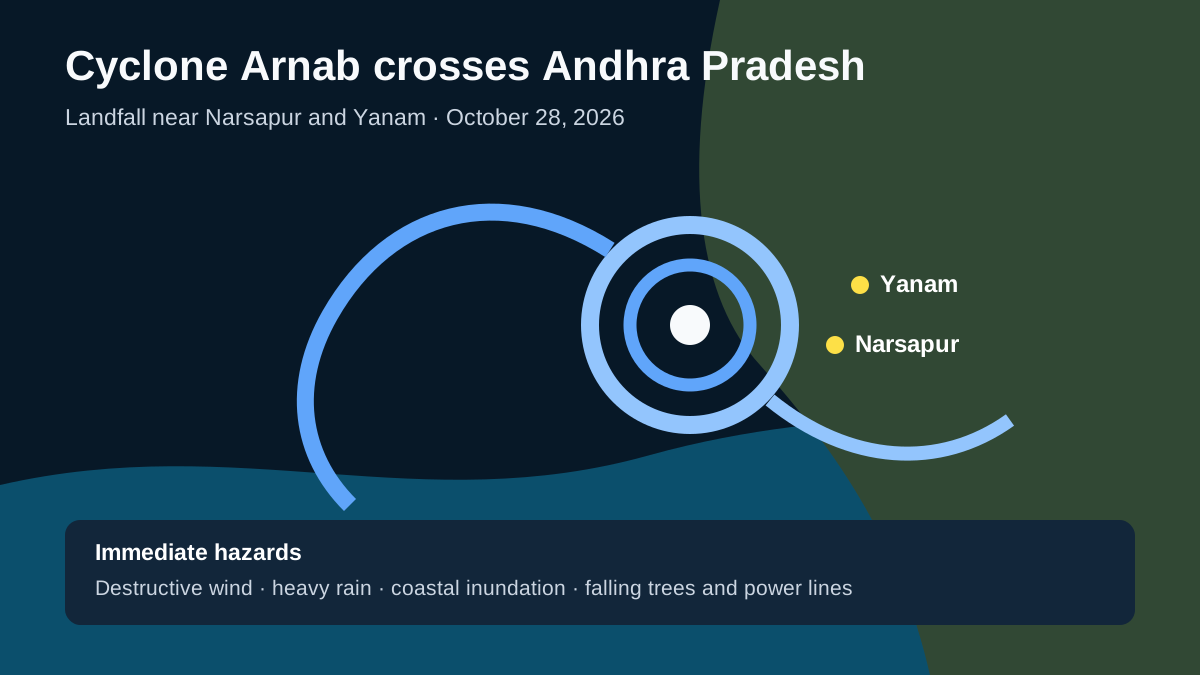
Very Severe Cyclonic Storm Arnab crossed the Andhra Pradesh and Yanam coasts near Narsapur early Wednesday, October 28, after spending hours close to shore. The India Meteorological Department placed the center about 30 kilometers east of Narsapur and 45 kilometers south-southwest of Yanam shortly before the crossing, with sustained winds around 115–125 kilometers per hour and stronger gusts.
The landfall process took several hours because the storm moved slowly near the coast. That does not mean conditions ended when the center crossed: damaging winds, heavy rain, high waves and coastal inundation can continue across a broad area after the eye or center moves inland.
Evacuations and early damage
Andhra Pradesh officials said 84,396 people had moved to 290 shelters, according to The Indian Express. The Associated Press later reported at least 89,000 evacuees; the figures appear to reflect different reporting times rather than a contradiction. More than 30,000 fishing boats had returned to shore, and authorities moved nearly 5,000 pregnant women closer to health facilities as a precaution.
Chief Minister N. Chandrababu Naidu said no casualties had been reported at the cutoff used for this article. Local officials reported hundreds of uprooted trees, fewer than 100 damaged power poles in Kakinada district and a washed-out section of the Uppada coastal road. Early reports are incomplete and may change as crews reach affected communities.
What remains dangerous
IMD warnings cover destructive winds, heavy to extremely heavy rainfall, rough seas and storm surge along vulnerable low-lying sections of the coast. Fallen trees and wires, flooded roads, unstable buildings and contaminated water can cause injuries after the strongest winds pass.
- People in shelters: remain until local authorities give an all-clear; a weakening cyclone can still produce flooding and dangerous gusts.
- Residents near the coast or waterways: avoid floodwater, beaches, damaged roads and downed electrical lines.
- Families checking property: wait for official access guidance and do not enter visibly damaged buildings.
- Travelers: verify rail, road and flight status with operators because cancellations and route changes can outlast landfall.
This is general emergency information, not real-time local instruction. Follow Andhra Pradesh disaster-management alerts, IMD bulletins and district authorities.
Agriculture and essential services
Officials identified more than 700,000 hectares of field crops and a larger area of horticultural production as potentially exposed. Exposure is not the same as confirmed loss; damage depends on wind intensity, saltwater intrusion, standing water and how quickly fields drain. Preliminary estimates should not be treated as final compensation totals.
Authorities positioned generators, water tankers, medical teams, drones and thousands of utility workers. Immediate priorities are clearing roads, restoring power only when winds permit, protecting drinking-water supplies and maintaining food and medicine at relief camps.
Fact, analysis, forecast and opinion
Verified fact: Arnab crossed the Andhra Pradesh coast near Narsapur and Yanam after more than 84,000 people were sheltered. Analysis: advance evacuation appears to have reduced immediate loss of life, though the full damage picture is not yet available. Forecast: the system should weaken inland, but rainfall and flooding can continue beyond the landfall zone; exact local impacts remain uncertain. Opinion: Health Politics Daily supports following official warnings and delaying return until hazards are assessed.
How this differs from the earlier report
Our October 26 article covered the forecast track and preparations before landfall. This update reports the observed crossing, shelter totals and first damage assessments. Readers should use the newer official bulletins for present conditions while retaining the earlier article as forecast context.
Related reporting includes our coverage of post-flood return hazards in the Four Corners and coastal closures after the UAE oil spill.
Bias Lens: why source type matters more than ideology here
Verified baseline: IMD observed the storm near the coast and issued wind and rainfall warnings; Andhra Pradesh officials reported large-scale evacuations and no confirmed deaths at the reporting cutoff.
A forced left-center-right comparison would add little to a fast-moving weather emergency. Official — IMD: prioritizes coordinates, intensity and hazard forecasts. International wire — Associated Press: emphasizes evacuation scale and regional disruption for a global audience. Local reporting — The Indian Express: adds district-level shelter, crop and infrastructure details. The differences reflect timing, geography and editorial purpose—not reliable evidence of partisan disagreement.
What remains uncertain
A complete casualty count, crop-loss estimate and infrastructure assessment were not available at publication. The storm’s inland rainfall totals, river response, duration of power outages and timetable for residents to leave shelters will depend on local conditions. Early no-casualty statements should be treated as provisional until search and assessment work is complete.
Principal sources
- India Meteorological Department sea-area bulletin
- Andhra Pradesh State Disaster Management Authority cyclone portal
- Associated Press
- The Indian Express
No suitable directly relevant official or publisher-authorized video with clear embedding permission was available, so none was embedded.
No comments yet.