China · Party governance · International politics
China Opens Fifth Plenum Focused on Party Discipline and Xi’s Authority
The four-day meeting puts internal discipline and enforcement at the center as the Communist Party prepares for its 2027 leadership congress.
By Health Politics Daily News Desk · October 26, 2026 at 6:01 a.m. ET

Watch in this article
Pumpjack operating at the Kern River Oil Field
A short CC0 field video provides visual context for reporting on oil production and fuel supply.
Thomas Farley / Wikimedia Commons · CC0 1.0 · License and source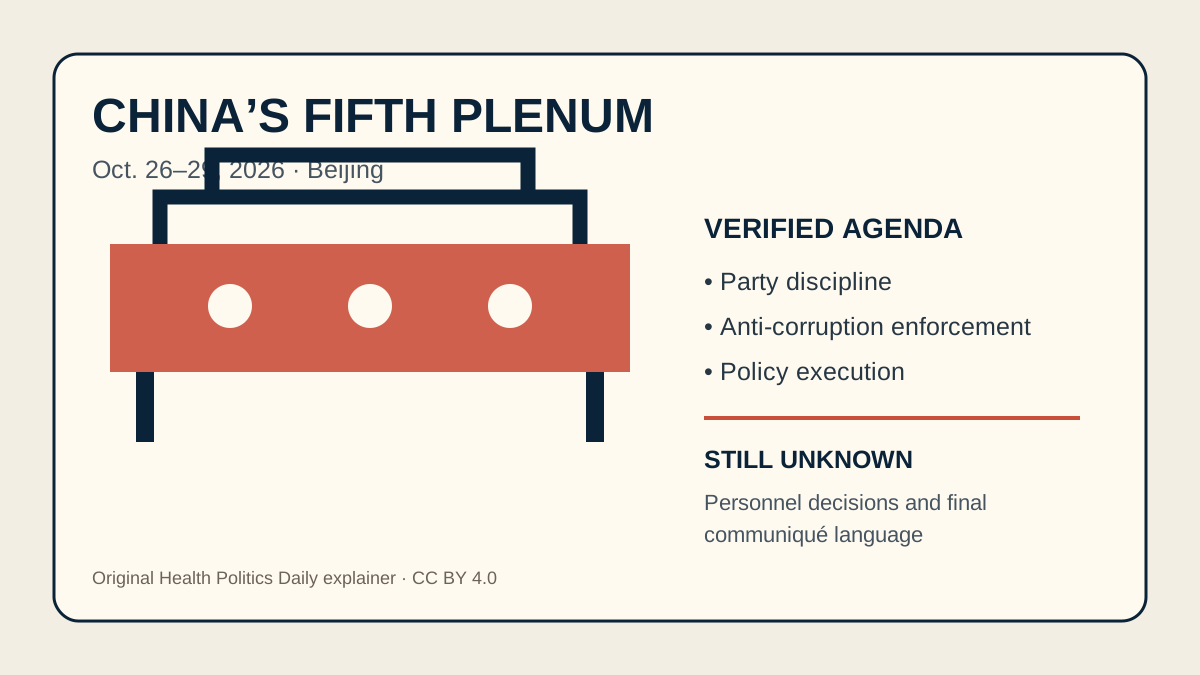
Verified baseline
The Central Committee of China’s Communist Party opened its fifth plenary session in Beijing on Monday. The official Xinhua announcement says the meeting runs through October 29 and will examine a draft regulation on the party’s Central Commission for Discipline Inspection.
The official framing emphasizes “full and rigorous Party self-governance,” stronger supervision and implementation of decisions made by the party leadership. Reuters and the Associated Press reported that the meeting also arrives amid a continuing anti-corruption campaign and questions about senior personnel. No final communiqué or confirmed leadership changes had been announced when this article was published.
Why the meeting matters
Plenums are closed-door meetings where the Central Committee reviews major policy and organizational questions. This session is unusually consequential because it comes roughly a year before the 2027 Party Congress, when top posts and leadership bodies are expected to be set for another five-year cycle.
A discipline-centered agenda can influence more than internal rules. It can affect how officials implement economic, security and social policy, how aggressively agencies investigate misconduct and how cautious local cadres become when making decisions. The formal agenda does not by itself prove that any named official will be promoted or removed.
Practical implications
For businesses and governments dealing with China, the most useful signals will be the final communiqué and any later personnel notices—not rumor-driven lists circulating before the meeting ends. Changes in regulatory enforcement or policy implementation generally emerge through subsequent rules, appointments and agency actions.
For readers, claims about a “purge,” succession or a fourth term should be treated as analysis unless supported by an official decision or multiple independent sources. China’s political system releases limited information about elite deliberations, so confident forecasts often exceed the public evidence.
Fact, analysis, forecast and opinion
Verified fact: the fifth plenum has opened, lasts four days and is considering a discipline-inspection regulation. Analysis: placing enforcement at the center strengthens Xi Jinping’s institutional control and may reinforce officials’ incentives to follow central directives. Forecast: the closing communiqué may clarify priorities, but personnel outcomes cannot be predicted reliably. Opinion: Health Politics Daily takes no position on China’s leadership and favors transparent publication of decisions that affect the public.
Bias Lens: discipline, power and succession
Verified baseline: official sources confirm the meeting, dates and discipline-focused agenda; they do not confirm a succession decision or specific personnel action.
Center-oriented wire coverage: Reuters foregrounds the meeting’s formal opening, anti-corruption context and uncertainty over appointments. Left-leaning coverage: The Guardian gives more weight to Xi’s consolidation of power and the political effects of the crackdown. Center-right financial coverage: The Financial Times emphasizes elite politics, institutional control and implications for policy continuity. These are differences in emphasis and audience; the official agenda remains the common factual floor.
What remains uncertain
The final communiqué, any personnel decisions and the practical scope of the discipline regulation remain unknown. It is also unclear whether the meeting will offer meaningful clues about the 2027 leadership lineup or Xi’s longer-term plans. Those questions should remain open until decisions are published.
Principal sources
- Xinhua — official opening notice and agenda
- Reuters — political and anti-corruption context
- Associated Press — leadership and policy context
No suitable directly relevant official or publisher-authorized video with clear embedding permission was available, so no video was embedded.