FINANCE — AGRICULTURE — ECONOMIC POLICY
U.S. Farm Debt Tops $605 Billion—and Official Data May Miss More
Farm borrowing has reached a record in inflation-adjusted terms. Supplier, equipment and other nontraditional credit may leave an important part of the liability picture outside federal estimates.
By Health Politics Daily News Desk · Published Thursday, October 8, 2026 at 10:02 a.m. America/New_York · Approximately 8 minutes

Watch in this article
Pumpjack operating at the Kern River Oil Field
A short CC0 field video provides visual context for reporting on oil production and fuel supply.
Thomas Farley / Wikimedia Commons · CC0 1.0 · License and source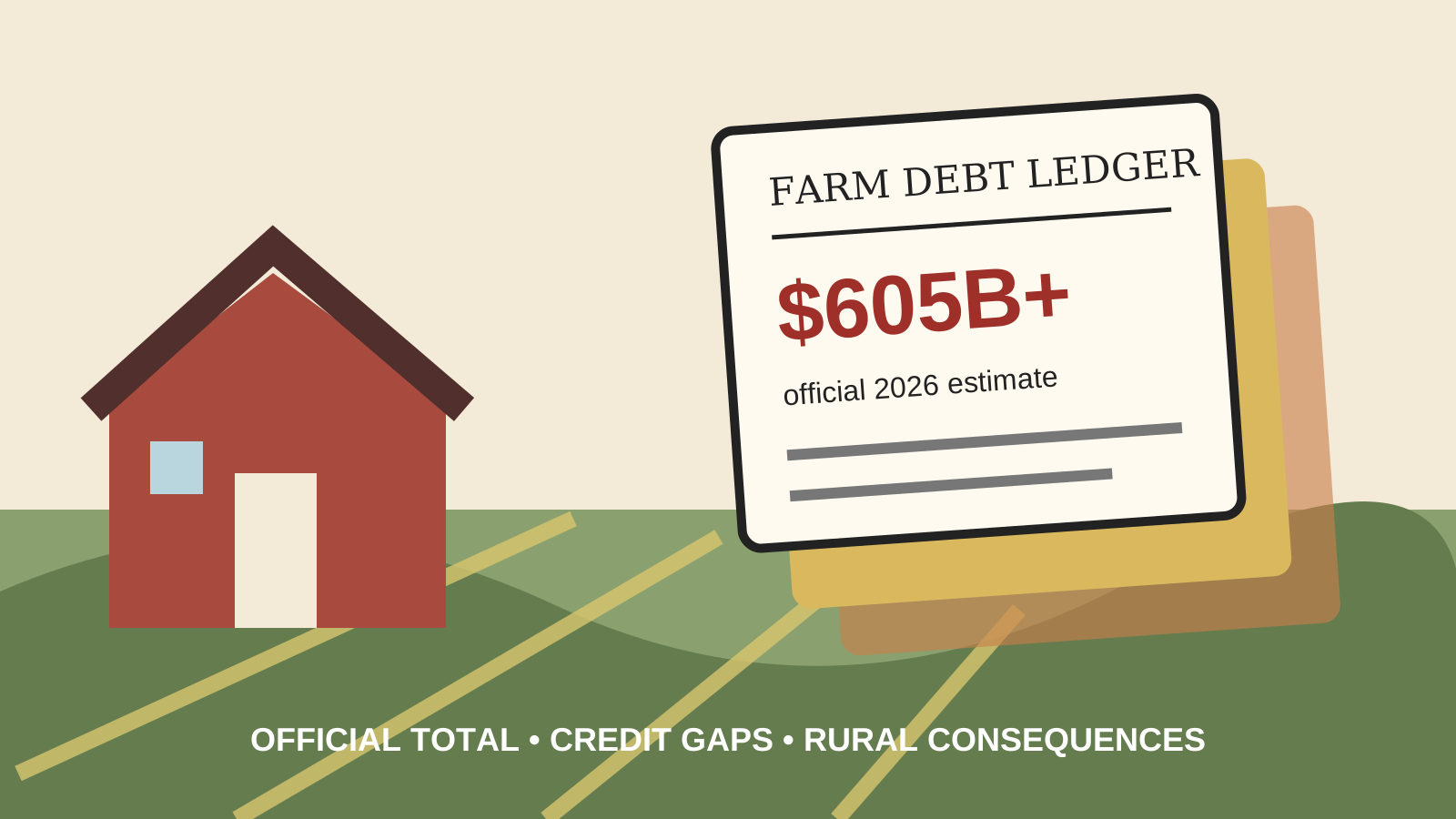
Verified Baseline
Official farm debt is above $605 billion
Inflation-adjusted U.S. farm debt has more than doubled since 2000 and now exceeds $605 billion, a record, according to the latest Department of Agriculture estimates reported by Reuters. USDA’s Economic Research Service publishes the underlying farm-income and balance-sheet series and says its current 2026 figures are forecasts that may be revised.
The $605 billion figure is the best national estimate currently available. It is not a complete census of every obligation held by every farm.
The Measurement Gap
More borrowing is happening outside traditional banks
Farmers commonly finance seed, fertilizer, machinery and other operating needs through suppliers, cooperatives, equipment dealers and newer financial firms. Some of those obligations do not appear fully in the surveys and administrative records used to build the national balance sheet.
USDA officials told Reuters that declining survey-response rates and growth in vendor credit have created gaps in the government’s ability to measure farm debt. One sign of the shift: Land O’Lakes said its loan commitments expanded from about $100 million to more than $1 billion in a year. That company example shows rapid growth in one channel; it does not establish the size of the nationwide undercount.
USDA-backed research is examining nontraditional agricultural credit, but comprehensive results are expected to take roughly two years. No authoritative alternative total is available now.
Why It Matters
Incomplete debt data can hide pressure until repayment problems surface
Many crop producers are being squeezed by weak commodity prices, high input costs, disrupted export markets and rising fuel and fertilizer expenses. When banks tighten underwriting, a farm can add supplier or equipment credit to an existing operating loan. Each lender may see only part of the borrower’s total obligations.
Analysis: the public-policy problem is not simply that debt is high. It is that regulators, lenders and borrowers may be making decisions from different and incomplete balance sheets. That can complicate risk assessment, emergency aid design and negotiations when a farm needs to restructure.
Farm stress also reaches beyond the farm gate. Delayed equipment purchases affect rural dealers; defaults can weaken local lenders and suppliers; and financial pressure can accelerate land sales or consolidation. None of that proves a nationwide banking crisis or an imminent food shortage.
Practical Implications
What farmers, lenders and consumers can reasonably take from the data
- Borrowers: a full debt inventory should include trade credit, input financing, equipment obligations and personal guarantees—not only bank loans.
- Lenders and suppliers: underwriting based on one credit channel may miss obligations held elsewhere; shared documentation matters more as financing becomes fragmented.
- Policymakers: the next scheduled USDA farm-income forecast is December 2, but closing the nontraditional-credit gap will require better reporting, not merely another forecast update.
- Consumers: record farm debt can affect rural investment and production decisions, but it does not translate mechanically into a specific grocery-price increase.
For wider economic context, see our reports on oil, yields and borrowing costs and the September U.S. jobs picture.
What Remains Uncertain
The hidden total, distribution and default risk are not known
There is no verified estimate of how much debt lies outside current measures, which regions or commodities are most exposed, or how often multiple credit lines are being stacked. Farm bankruptcies have risen, but filings alone do not reveal the full financial condition of operating farms.
Forecast: higher borrowing costs and weak margins would likely increase refinancing pressure if they persist. Weather, commodity prices, trade flows, government support and interest rates can change that trajectory.
Opinion: Health Politics Daily takes no position on farm subsidies or credit policy. Public debate should distinguish the confirmed record debt level from an unmeasured—and therefore still uncertain—additional amount.
Bias Lens: how coverage frames farm debt
USDA’s official estimate puts farm debt above $605 billion. Federal officials say nontraditional credit is not fully captured, but no verified comprehensive alternative total exists.
Center coverage: Reuters frames the story as a measurement and financial-system problem, emphasizing vendor credit, survey gaps and the difficulty of seeing stacked obligations.
Left- and right-leaning coverage: at publication, we did not find sufficiently detailed, directly comparable reporting from established left- and right-leaning outlets on this new measurement finding. Broader farm-economy commentary often assigns blame differently—trade policy, market concentration, regulation or federal spending—but importing those arguments here would force a false comparison.
The useful distinction is between a verified official total and an evidence-backed concern that it is incomplete. “Undercounted” does not mean analysts know the missing amount.
Principal Sources
Official data and corroborating reporting
- USDA Economic Research Service — Farm Income and Wealth Statistics
- Reuters — U.S. farm debt and nontraditional-credit measurement gaps
- Reuters — financial pressure in U.S. agriculture
No suitable directly relevant official or publisher-authorized video with clearly confirmed embedding permission was available.