WORLD — NORTHERN ETHIOPIA
Ethiopian Forces Retake Mekelle Airport: What Is Confirmed
Federal forces have retaken the main airport serving Tigray’s capital, according to three sources. The gain does not establish control of Mekelle or end renewed fighting.
By Health Politics Daily News Desk · Published Saturday, October 3, 2026 at 8:03 a.m. America/New_York · Approximately 7 minutes
Verified Baseline
Three sources say federal forces control Alula Aba Nega Airport
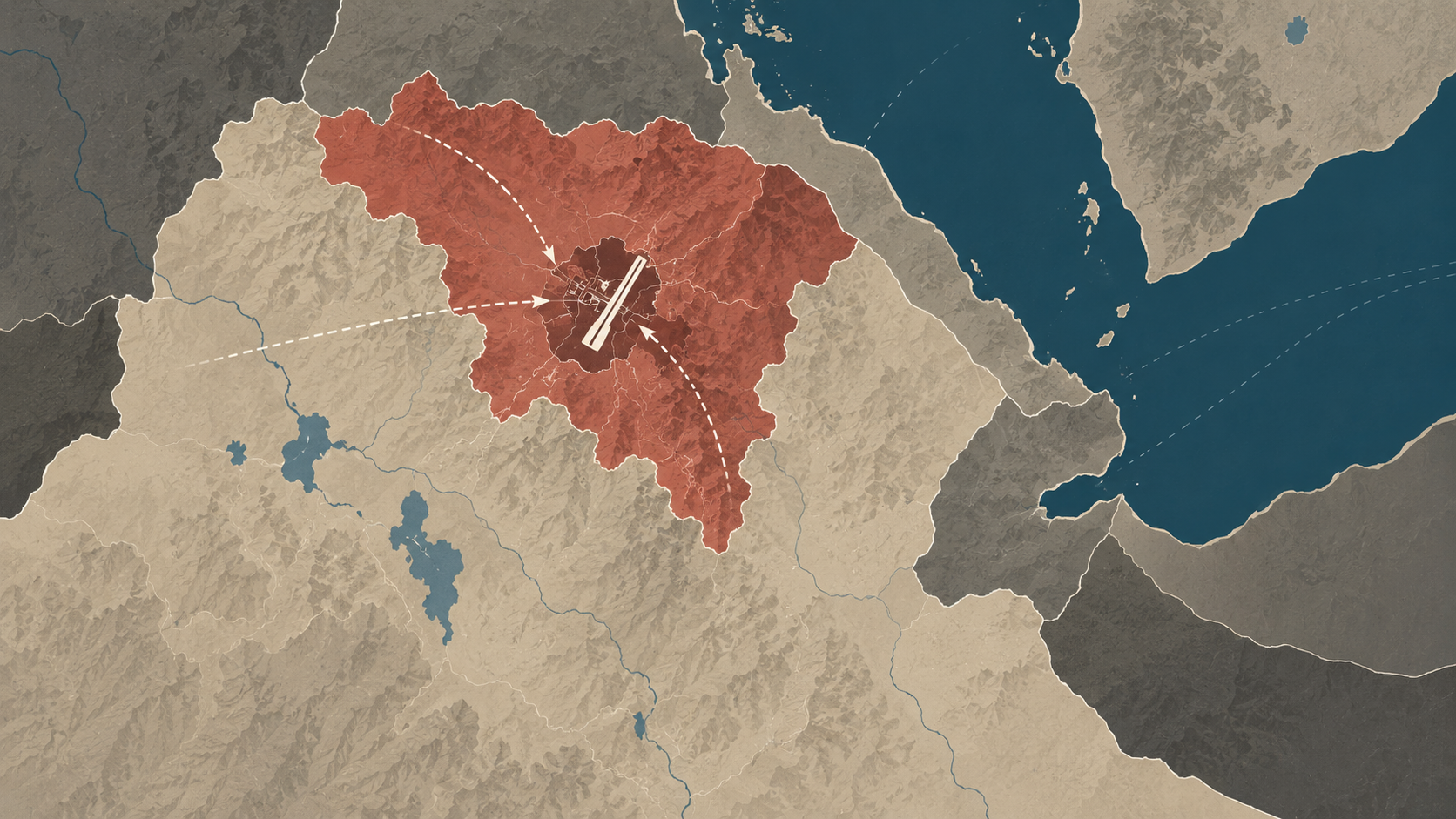
Ethiopian federal forces regained Alula Aba Nega Airport, about 10 kilometers from central Mekelle, according to a humanitarian source, a person with knowledge of events in the city and a resident cited by Reuters on Saturday. The resident reported gunfire outside the city center.
Reuters said it could not independently verify every battlefield assertion, and the Tigray People’s Liberation Front was not immediately available for comment. A source close to the TPLF said Mekelle was encircled. Health Politics Daily therefore treats control of the airport as supported by multiple sources, while not presenting government control of the city as established.
What Changed
The airport has changed hands twice since fighting resumed
Tigrayan forces seized airports at Mekelle, Axum and Shire on September 23, prompting Ethiopian Airlines to suspend scheduled flights. The federal advance reverses part of that opening gain and gives government forces a transport hub beside the regional capital.
An airport can support logistics, evacuation and surveillance, but a runway changing hands does not prove that civilian flights can safely resume. Airlines and aviation authorities would need to assess the runway, airspace, security and ground operations first.
Why It Matters
Civilians face a growing access and displacement crisis
Residents have reported closed banks and shops, shortages of cash and fuel, disrupted communications and new displacement. The loss of scheduled flights can complicate medical referrals, humanitarian movement and family reunification. Control of the facility could eventually restore access, but only if fighting subsides and civilian operations are protected.
The broader danger is escalation beyond Tigray. Ethiopia and Eritrea have severed diplomatic ties. Ethiopia has accused Eritrea, Sudan and Egypt of supporting the opposition alliance; all three deny the allegation. Those contested claims are not proof of direct participation.
Context
The 2022 Pretoria peace agreement is under severe strain
The African Union-brokered cessation of hostilities ended the 2020–2022 war between the federal government and the TPLF. On September 23, the AU again called the agreement the cornerstone of peace and urged immediate de-escalation.
The renewed fighting is the most serious since that settlement. The earlier war caused mass death and a collapse of health and food systems. Exact estimates remain disputed, but the human consequences make claims of a quick or decisive military solution especially important to scrutinize.
Practical Implications
Travelers and families should not assume the airport has reopened
People with planned travel should check Ethiopian Airlines directly and avoid relying on battlefield announcements as flight guidance. Humanitarian and medical organizations should verify road, airspace and communications conditions through their own security channels.
Intermittent phone and internet service can delay confirmation of safety. An inability to reach someone is not, by itself, evidence that the person has been harmed.
What Remains Uncertain
The status of central Mekelle and the next phase are unresolved
Public reporting has not established who controls every approach to Mekelle, the condition of airport infrastructure, casualty totals or whether civilian flights could resume. The federal advance could pressure the TPLF politically, but it could also shift fighting into dense civilian areas.
Verified fact: multiple sources report federal control of the airport. Analysis: the site improves access and leverage but does not settle the conflict. Forecast: claims that the fall of Mekelle—or a wider regional war—is inevitable remain predictions.
Bias Lens: battlefield gains, failed peace and regional risk
Multiple sources place the airport under federal control; the status of central Mekelle, casualty figures and readiness for civilian use remain unverified.
Reuters, a center-oriented wire service, leads with the airport’s capture while qualifying battlefield claims. The left-leaning Washington Post emphasizes the human cost and danger of renewed civil war. The right-leaning American Conservative focuses on unresolved failures in the Pretoria agreement and cautions against simplistic intervention. These labels describe broad editorial orientation, not the accuracy of any specific claim; the difference here is mainly emphasis.
Principal Sources
Evidence and reporting used
- Reuters — airport control and conditions in Mekelle
- African Union — de-escalation statement
- Associated Press — diplomatic rupture and civilian disruption
- Associated Press — initial airport seizure and flight suspension
No suitable directly relevant authorized video with clear embedding permission was available.