International Politics · Haiti · Security
About 1,000 Salvadoran Troops Deployed to Haiti, Reuters Source Says
The deployment follows a gang ambush that left four Salvadoran aviation technicians missing. El Salvador has not confirmed the reported total, and the expanded contingent’s command and duration remain unclear.
By Health Politics Daily News Desk · October 27, 2026 at 4:00 p.m. ET
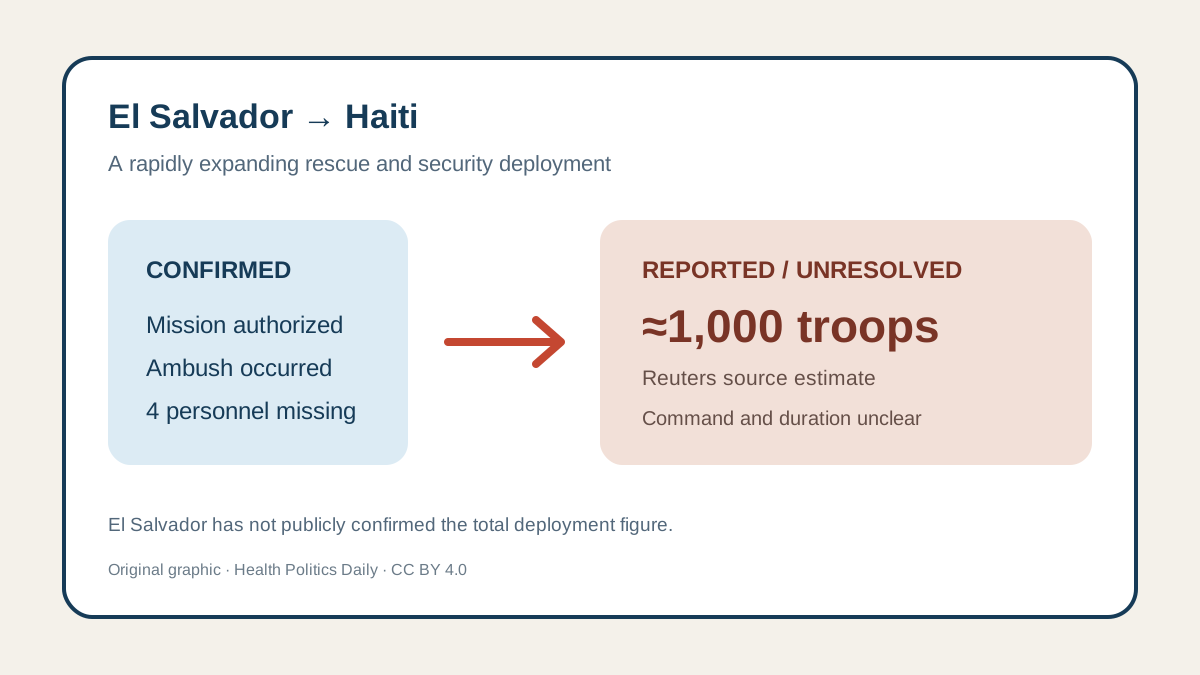
Verified baseline
A Haitian security official told Reuters that around 1,000 Salvadoran soldiers had arrived in Haiti through a series of deployments. The deployment followed an October 18 gang ambush outside Port-au-Prince in which four Salvadoran aviation technicians serving with the U.N.-backed Gang Suppression Force went missing after leaving a burning armored vehicle.
The troop total is credible reporting from an identified category of source, not an official public count. President Nayib Bukele has not said how many personnel El Salvador plans to send, and his office did not respond to Reuters. A U.S. military official confirmed that U.S. Southern Command provided C-130 aircraft to help transport Salvadoran troops.
What official records confirm
El Salvador’s legislature authorized military participation in the Gang Suppression Force for an initial 12-month period beginning October 2. A U.N. Security Council resolution extended the force’s mandate through March 31, 2027 and recognized its status agreement with Haiti.
Before the ambush, a U.N. progress report recorded at least 124 Salvadoran personnel in the mission. The Associated Press reported that 100 Salvadoran special-forces soldiers arrived October 22 and that another 100 were expected that night. The Gang Suppression Force confirmed only that “a contingent” had arrived to support search and security operations.
Why the expansion matters
If the Reuters estimate is accurate, the new Salvadoran contingent would be several times larger than El Salvador’s documented pre-ambush presence and would materially change the multinational force’s composition. The U.N. report counted 1,213 uniformed personnel from six countries on August 31, against an authorized ceiling of 5,500.
The force is intended to support Haitian police against armed groups that control or influence large parts of Port-au-Prince and key roads. Nearly 1.5 million people have been displaced, according to Reuters. A larger deployment could strengthen search, transport and security capacity, but rapid expansion without public command arrangements can also complicate accountability, civilian protection and coordination.
What civilians should know
Residents near active operations should rely on instructions from Haitian civil-protection and police authorities and avoid areas subject to armed clashes or movement restrictions. Reports about troop movements or the missing personnel can change quickly; unverified social-media claims should not be treated as official safety guidance.
The deployment does not itself resolve Haiti’s humanitarian crisis or restore elected government. Security operations affect access to hospitals, food, fuel, schools and displacement sites, so humanitarian access and safeguards for civilians remain central measures of impact.
Fact, analysis, forecast and opinion
Verified fact: El Salvador is contributing personnel to a Haiti-authorized, U.N.-backed mission, additional contingents arrived after the ambush, and four Salvadoran technicians remain missing. Attributed report: one Haitian security official put the recent deployment at around 1,000 troops. Analysis: that scale would make El Salvador a substantially larger operational actor in Haiti. Forecast: the number and mission may change as the search continues; there is no reliable public timetable. Opinion: Health Politics Daily supports prompt disclosure of command, mission scope and civilian-protection arrangements while operational security is preserved.
Bias Lens: rescue mission or military escalation?
Verified baseline: four Salvadoran mission members disappeared after an ambush, additional Salvadoran troops arrived with Haiti’s authorization, and the roughly 1,000 figure remains sourced reporting rather than an official total.
Left-leaning coverage: El País emphasizes Bukele’s deployment of elite troops and the risks of a forceful response. Center coverage: Reuters foregrounds the newly reported scale and the unknown command structure, while AP focuses on the rescue operation, gang-held territory and force-readiness concerns. Right-leaning business coverage: The Wall Street Journal emphasizes Haiti’s authorization and the mission’s 5,500-person ceiling.
These differences concern emphasis—Bukele’s escalation, the attributed headcount, or the mission’s legal and operational framework. They do not create competing facts about whether every newly reported soldier has been independently counted.
What remains uncertain
El Salvador has not confirmed the 1,000-person estimate, disclosed the current force breakdown or explained who commands the new contingent. The duration, rules of engagement, cost, exact tasks and status of the four missing technicians also remain unresolved. No gang has publicly accepted responsibility for the ambush.
Principal sources
- Reuters — reported deployment total and transport confirmation
- U.N. Security Council — mission mandate and Haiti status agreement
- U.N. Gang Suppression Force progress report — personnel and operations baseline
- Associated Press — initial special-forces deployments and mission statement
- United Nations in El Salvador — condemnation of the attack
No suitable directly relevant official or publisher-authorized video with clear downstream embedding permission was available, so no video was embedded.