Finance · Technology · Workforce
Microsoft Offers Voluntary Buyouts to About 60,000 Employees
The offer reaches roughly 27% of Microsoft’s workforce across four countries. That is an eligibility figure—not a count of layoffs, acceptances or eventual departures.
By Health Politics Daily News Desk · October 27, 2026 at 2:10 p.m. ET
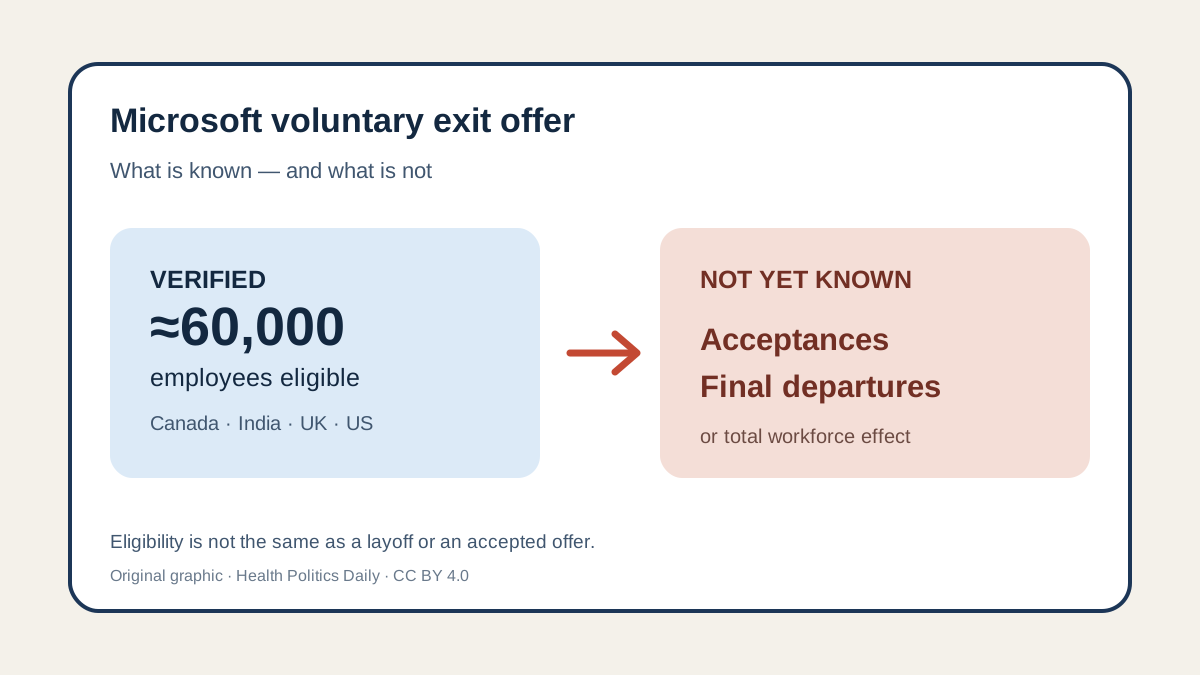
Verified baseline
Microsoft announced a time-limited voluntary exit offer for eligible employees at level 70 and below in participating organizations in Canada, India, the United Kingdom and the United States. The company says the package includes financial support and career-planning resources, and that eligible workers will receive individual details by email.
Reuters and the Associated Press report that about 60,000 employees are eligible. With Microsoft reporting 223,000 employees as of June 30, that is roughly 27% of its workforce. Microsoft did not publish the 60,000 figure in its announcement.
What 60,000 does—and does not—mean
“Eligible” means an employee may receive and consider an offer. It does not mean 60,000 workers have accepted, will leave or are being laid off. Microsoft says participation is voluntary and that participating organizations vary according to business priorities, customer commitments and workforce needs.
The company has not publicly disclosed an acceptance target, the value of every package or an expected net reduction in headcount. Those distinctions matter because departures could be offset by hiring elsewhere, while a voluntary program may attract fewer—or more—participants than management expects.
Why Microsoft is making the offer
Microsoft says it is giving employees more choice as the company evolves. Reuters places the program in a broader effort to contain costs while Microsoft expands artificial-intelligence infrastructure; the news service forecasts about $175 billion of capital spending in calendar 2026. That spending context helps explain investor attention, but Microsoft’s public post does not say that every voluntary departure will fund AI investment.
The company previously offered a Voluntary Retirement Program to eligible U.S. employees. In a July update, Microsoft said more than 30% of eligible workers accepted that earlier offer. The prior result is context, not a reliable forecast for a broader, differently structured program across four countries.
Practical implications for employees
Workers considering an offer should rely on their personalized Microsoft documents for deadlines, eligibility and benefits. Relevant questions may include severance timing, health coverage, equity vesting, retirement benefits, tax treatment, immigration status and whether accepting waives legal claims. Those consequences can differ by country and individual circumstances; this article is general information, not legal, tax or investment advice.
Employees do not need to infer their status from a news headline. Microsoft says eligible people will be contacted directly. Unexpected messages asking for credentials or payment should be verified through internal company channels.
Fact, analysis, forecast and opinion
Verified fact: Microsoft created a voluntary offer for eligible employees in four countries, and independent reporting puts eligibility at about 60,000. Analysis: the breadth of eligibility makes the program material even though its ultimate workforce effect is unknown. Forecast: Microsoft’s coming financial disclosures may clarify costs, but participation cannot be predicted from the eligibility count alone. Opinion: Health Politics Daily considers precise labeling essential; calling 60,000 “layoffs” would overstate what is currently known.
Bias Lens: buyouts, layoffs or employee choice?
Verified baseline: the program is voluntary; roughly 60,000 employees are reported eligible; no acceptance total or final headcount reduction has been announced.
Company framing: Microsoft emphasizes employee choice, support and differing business needs. Center coverage: Reuters and the Associated Press foreground the scale and connect it to cost discipline and AI spending. Business-focused coverage: The Wall Street Journal similarly leads with the roughly 60,000-person reach.
We did not force a left-versus-right comparison because sufficiently detailed, directly relevant coverage across those ideological categories was not available at review time. The meaningful difference is between Microsoft’s choice-and-support framing and independent outlets’ emphasis on scale, spending and workforce strategy.
What remains uncertain
It is not yet known how many employees will accept, which teams will record the most departures, whether Microsoft will replace some roles, what the program will cost or how it will affect products and customers. The company’s next earnings report may provide financial context, but it may not settle those workforce questions.
Principal sources
- Microsoft — voluntary exit offer announcement
- Reuters — eligibility, workforce and spending context
- Associated Press — workforce share and earnings context
- The Wall Street Journal — scope of the offer
No suitable directly relevant official or publisher-authorized video with clear embedding permission was available, so no video was embedded.