International politics · Czech Republic · Press freedom
Czech Lawmakers Advance Public Media Funding Overhaul in Overnight Vote
The lower house sent a disputed plan to replace household broadcasting fees with state-budget funding to committees after a pre-dawn vote. The measure is not yet law.
By Health Politics Daily News Desk · October 24, 2026 at 6:01 a.m. ET
Verified baseline
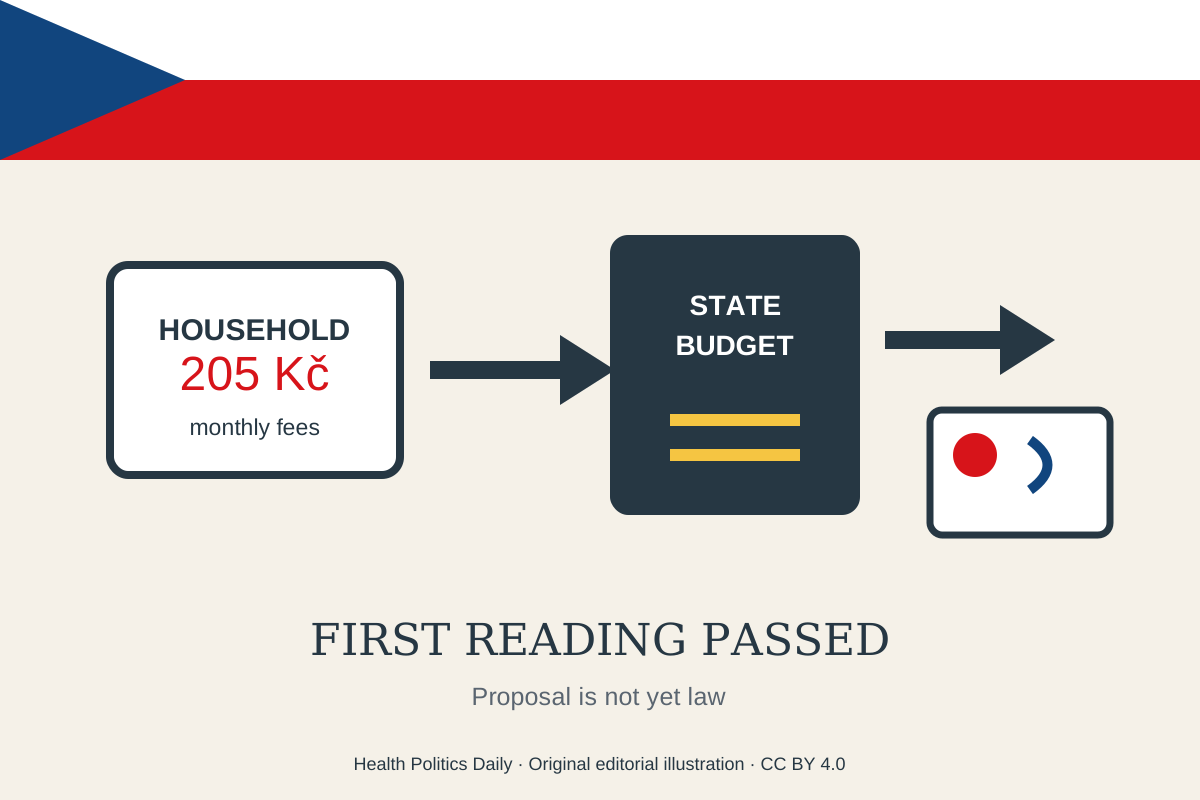
The Czech Chamber of Deputies voted at about 4:36 a.m. Saturday to advance a government bill that would abolish the monthly household fee supporting Czech Television and Czech Radio and finance them through the state budget. The vote completed the bill’s first reading and sent it to parliamentary committees; current fees remain in force.
Reuters reported that Speaker Tomio Okamura limited debate before the governing majority advanced the measure. Radio Prague International separately described the proposal and the opposition’s attempt to delay it.
What the proposal would change
Households currently pay 205 Czech crowns per month in combined television and radio fees. The bill would end that dedicated stream and replace it with annual appropriations. Reuters reported that the proposed 2027 allocation would be roughly 15% below current funding and remain nominally frozen for several years.
The government says ending licence fees follows a broader European shift, reduces household charges and can preserve editorial independence. Prime Minister Andrej Babiš rejected claims that the coalition plans to nationalize public media or weaken democracy.
Why critics object
Broadcaster employees, opposition parties and international journalism groups argue that annual budget decisions could make funding more vulnerable to political pressure. The European Broadcasting Union and other media organizations called for fuller scrutiny and stable, adequate, predictable funding.
Hundreds protested outside parliament during the overnight session. Public-media employees announced a one-day strike for November 3, and organizers planned another demonstration. Those actions express opposition; they do not determine whether the bill will ultimately pass.
What happens next
Committees can examine and amend the text before later lower-house readings. The Senate can review ordinary legislation, although the lower house can override a Senate veto. The president may also return a bill, subject to another lower-house vote.
For viewers and listeners, nothing changes immediately. Household fees remain payable, and Czech Television and Czech Radio continue operating under the current model. Employees and suppliers face longer-term uncertainty because any reduction would depend on final legislation and the enacted budget.
Fact, analysis, forecast and opinion
Verified fact: lawmakers advanced the bill at first reading and sent it to committees. Analysis: direct budget funding can work without editorial interference, but its safeguards and multi-year predictability determine how exposed broadcasters are to elected officials. Forecast: amendments, protests and legal or European-policy challenges are likely, but final passage is not assured. Opinion: Health Politics Daily takes no position on Czech funding policy; debate should distinguish a funding-model change from proof of censorship while still examining structural risks.
Related institutional context includes our coverage of a U.S. court order protecting press access and the importance of documented safeguards when public power and private interests overlap.
Bias Lens: household savings or political leverage?
Verified baseline: the bill would end licence fees, move funding into the state budget and reduce the initial allocation; it has cleared only its first parliamentary stage.
Center coverage — Reuters: emphasizes the rushed procedure, funding reduction and competing government and opposition claims. Public-broadcaster coverage — Radio Prague International: foregrounds the proposed financing mechanism, parliamentary conflict and employee strike. Industry advocacy — EBU and journalism groups: frames the process as a threat to sustainable, independent public media. A dependable left-center-right split had not formed in English-language coverage, so this lens compares institutional framing rather than assigning ideological labels.
What remains uncertain
The final funding formula, committee amendments and implementation date could change. It is also unknown whether the proposed allocation would force specific layoffs or programming cuts. Claims that the law would guarantee either efficiency or political control are forecasts, not established outcomes.
Principal sources
- Reuters — overnight vote, funding figures and responses
- Radio Prague International — bill and parliamentary process
- European Broadcasting Union — joint statement
No suitable directly relevant official or publisher-authorized video with clear embedding permission was available, so none was embedded.