Health care · Justice Department · Consumer protection
Justice Department Charges 15 in Los Angeles Health-Care Fraud Cases
Prosecutors say the cases involve about $2 billion in allegedly fraudulent claims across addiction treatment, invasive artery procedures, hospice care and prescription drugs. Indictments and complaints are allegations, not findings of guilt.
By Health Politics Daily News Desk · October 22, 2026 at 1:59 p.m. ET

Watch in this article
Pumpjack operating at the Kern River Oil Field
A short CC0 field video provides visual context for reporting on oil production and fuel supply.
Thomas Farley / Wikimedia Commons · CC0 1.0 · License and source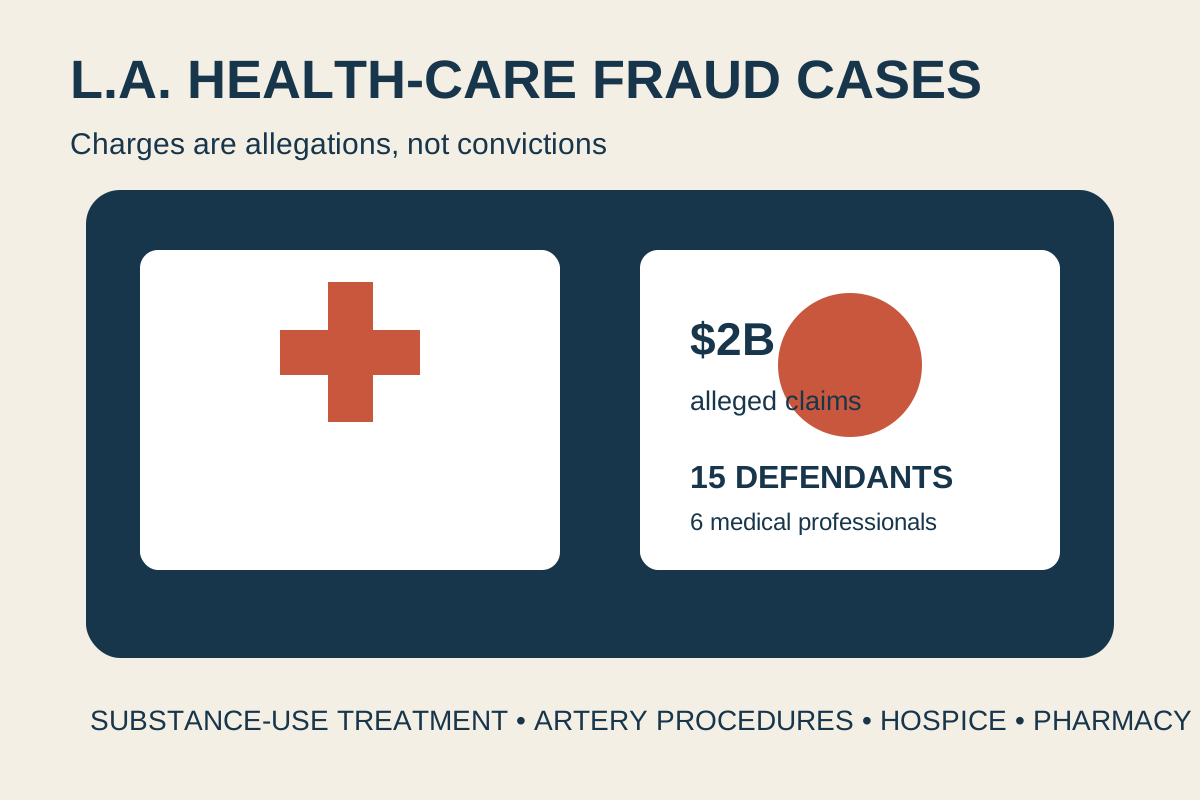
The Justice Department announced charges against 15 defendants, including six medical professionals, in a group of Los Angeles-area health-care fraud cases. Its October 22 release says the alleged schemes generated roughly $2 billion in claims submitted to government and private health programs.
The largest component is an alleged $1.6 billion substance-use-treatment scheme. Prosecutors say vulnerable people were recruited with travel, housing, cash and drugs, then cycled through facilities for treatment that was unnecessary, inadequate or not provided. Separate cases concern about $135 million billed for allegedly unnecessary artery-clearing procedures, more than $138 million in hospice claims and a previously charged $270 million Medi-Cal pharmacy scheme.
Why the headline number needs context
The $2 billion figure describes alleged billings across multiple matters. It is not necessarily the amount programs paid, a proven taxpayer loss or money already recovered. Some defendants face indictments or complaints; some are charged by information, and one related manager has pleaded guilty. The government states that all defendants are presumed innocent unless proven guilty.
The cases also differ in their alleged harm. Some center on billing and kickbacks; others include claims that patients underwent medically unnecessary invasive procedures or were enrolled in hospice without knowing it. Those allegations will be tested through evidence, pleas and trials.
Fact, analysis, forecast and opinion
Verified fact: federal prosecutors filed charges against 15 people and arrested eight on October 22. Analysis: data analytics appear central to identifying unusually high billing patterns, but statistical outliers are investigative leads rather than proof by themselves. Forecast: litigation may take years, and recoveries will probably be lower than total alleged claims. Opinion: Health Politics Daily supports enforcement that protects patients while preserving the presumption of innocence.
Practical implications
- Medicare beneficiaries who discover unexpected hospice enrollment or procedures on their records can contact Medicare and the HHS inspector general.
- Patients connected to the artery-procedure case may use the Justice Department's victim-notification system.
- Providers should expect billing analytics, ownership records and referral payments to receive close scrutiny.
For related context, see our coverage of Medicare costs in 2027 and the HHS kidney-care roadmap.
Bias Lens: taxpayer fraud, patient harm or enforcement power?
Verified baseline: charges were filed, but most allegations have not been adjudicated. The headline total combines claims submitted across distinct cases and should not be treated as a final loss figure.
Left-leaning — Los Angeles Times: earlier regional coverage focused on shell companies, beneficiary recruitment and patient-level consequences. Center — Associated Press: emphasized the charged conduct, arrest count and authorities' allegations while noting the defendants' legal posture. Right-leaning — Wall Street Journal: placed Southern California cases in a broader taxpayer-loss and enforcement strategy frame. These emphases are complementary; none substitutes for the court record.
What remains uncertain
The government has not yet proved the alleged schemes or established final losses. Pleas, motions, trials and sentencing could change the number of defendants held responsible. It is also unclear how much money can be recovered and whether the cases will produce broader payment-policy changes.
Principal sources
- U.S. Attorney's Office, Central District of California
- HHS-OIG Medicare Fraud Strike Force overview
- Associated Press background on Southern California enforcement
No suitable directly relevant official or publisher-authorized video with verified embedding permission was available, so none was embedded.